The Greenspan farewells are interesting, most of all (in my view) Milton Friedman's, as in his WSJ op-ed today:
"Over the course of a long friendship, Alan Greenspan and I have generally found ourselves in accord on monetary theory and policy, with one major exception. I have long favored the use of strict rules to control the amount of money created. Alan says I am wrong and that discretion is preferable, indeed essential. Now that his 18-year stint as chairman of the Fed is finished, I must confess that his performance has persuaded me that he is right -- in his own case."
Computer algorithms cannot translate languages because they cannot capture context and nuance. Can algorithm's (programmed by whom?) guide money growth? The original Friedman view was that rules are better than the hash that previous FRBs served up. Faint praise for rules. But a really good governor can beat simple algorithms.
The WSJ front-page adds: "Greenspan's Legacy Rests on Results, Not Theories ... Fed Chief's Biggest Idea Was to Avoid Having One: Embracing Ambiguity".
Can this wisdom be bottled -- and served to the new Chairman? The whole story is bearish for economic theory.
Tuesday, January 31, 2006
Monday, January 30, 2006
Preferences over policies
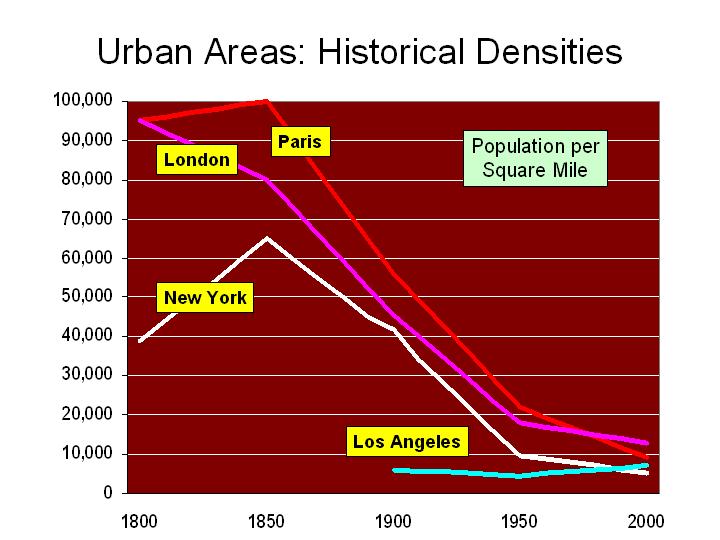
The tireless Wendell Cox assembles more interesting urban data than anyone. His graphic on metro area population density trends, comparing London, Los Angeles, New York and Paris shows long run convergence -- to now. In other words, policy differences matter very little. Preferences are more similar than different -- and they trump policy differences.
The graphic also shows that big density differences were in place about 100 years ago. Yet, this is the contrast that most "experts" still believe in. They spend too much time in the old cores of the European capitals when they travel -- and not enough time studying Wendell's numbers.
The graphic also shows that big density differences were in place about 100 years ago. Yet, this is the contrast that most "experts" still believe in. They spend too much time in the old cores of the European capitals when they travel -- and not enough time studying Wendell's numbers.


Thursday, January 26, 2006
Urban problems
We know that getting the prices wrong can be disastrous and we also know that when pricing is by planners, instead of markets, they are very likely to get them wrong -- setting off all sorts of problems. This is of course ironic because most planners think of their work as greatly beneficial.
Putting some meat on all of this has been the steady work of Don Shoup who looks at parking in cities and shows how many urban problems can be traced to planners misallocating scarce urban space because they have arrogated allocation functions to themselves.
Don makes a huge point, one that has been overlooked by practically everyone writing about land use and transportation.
Dan Klein's review (in the Independent Review) of Shoup's book adds interesting context and some elaboration. When it comes to ham-fisted municipal management of curbside parking, Shoup suggests that parking benefit districts, created to replace the city's role, would lead to better pricing. Klein adds: "It seems [that] in-vehicle meters could easily be adapted such that the driver punches in a parking-merchant code, which is then displayed by the meter. This system could operate nationwide among anyone who wanted to participate. Call it the Acme system. For example, if you wanted to rent out space in your personal driveway as parking space, you simply put up a sign announcing rates and saying that the customer must have an Acme-system meter and punch in the merchant code (provided by the sign). You then monitor parked vehicles for compliance. A car without an in-vehicle meter, or with the wrong merchant code, or perhaps the wrong rate code displayed would be a trespasser, and could be booted or otherwise held to account. You then collect your payments from the Acme system, who like American Express, takes a cut. With such an Acme system, we will easily be able tio imagine a reform movement in favor of capturing the potential revenues of parking supply."
New technologies can easily expand property rights, exchange, wealth and welfare. And there would be less work for the hamfisted.
Putting some meat on all of this has been the steady work of Don Shoup who looks at parking in cities and shows how many urban problems can be traced to planners misallocating scarce urban space because they have arrogated allocation functions to themselves.
Don makes a huge point, one that has been overlooked by practically everyone writing about land use and transportation.
Dan Klein's review (in the Independent Review) of Shoup's book adds interesting context and some elaboration. When it comes to ham-fisted municipal management of curbside parking, Shoup suggests that parking benefit districts, created to replace the city's role, would lead to better pricing. Klein adds: "It seems [that] in-vehicle meters could easily be adapted such that the driver punches in a parking-merchant code, which is then displayed by the meter. This system could operate nationwide among anyone who wanted to participate. Call it the Acme system. For example, if you wanted to rent out space in your personal driveway as parking space, you simply put up a sign announcing rates and saying that the customer must have an Acme-system meter and punch in the merchant code (provided by the sign). You then monitor parked vehicles for compliance. A car without an in-vehicle meter, or with the wrong merchant code, or perhaps the wrong rate code displayed would be a trespasser, and could be booted or otherwise held to account. You then collect your payments from the Acme system, who like American Express, takes a cut. With such an Acme system, we will easily be able tio imagine a reform movement in favor of capturing the potential revenues of parking supply."
New technologies can easily expand property rights, exchange, wealth and welfare. And there would be less work for the hamfisted.
Tuesday, January 24, 2006
Size and growth do not (much) matter
My student Bumsoo Lee knows more about traffic in cities than anyone I know. I asked him to look at U.S. metro areas (pre-2003 definitions) with over 500,000 population in 2000. The largest was New York and the smallest was Fort Wayne. The ratio of their populations was 42.2:1; the ratio of their 2000 drive-alone commute times (based on census tract averages) was 1.3:1.
In the ten years leading up to 2000, the fastest growing was Las Vegas and the opposite (greatest decline) was Scranton, 83.3% vs. -2.1%. The ratio of their commute times was 1.1:1.
Do faster-growing and larger places have worse traffic? Not nearly as bad as the alarmists suggest. The alarmists tend also to be central planners who have no use for markets or road pricing.
Yet in the absence of pricing and without the levels of transit use that all right-thinking people prescribe, size and growth do not deliver doomsday traffic.
How will they get their plans right when their prognoses are wrong?
In the ten years leading up to 2000, the fastest growing was Las Vegas and the opposite (greatest decline) was Scranton, 83.3% vs. -2.1%. The ratio of their commute times was 1.1:1.
Do faster-growing and larger places have worse traffic? Not nearly as bad as the alarmists suggest. The alarmists tend also to be central planners who have no use for markets or road pricing.
Yet in the absence of pricing and without the levels of transit use that all right-thinking people prescribe, size and growth do not deliver doomsday traffic.
How will they get their plans right when their prognoses are wrong?
Monday, January 23, 2006
Catch-22
Market efficiency (and all of the associated benefits) hinge on the rule of law. Trouble is that the making of law is often politicized and that works against market efficiency. This is the catchiest of Catch-22s, one that has driven many smart people (including James Buchanan) to contemplate desirable Constitutional amendments.
Writing in the latest Regulation, Daniel A. Crane elaborates "The Perverse Effects of Predatory Law". His point is that the law should not get in the way of competition that actually lowers prices. In fact, legal rulings that challenge alleged predatory pricing usually preserve a high-price status quo.
Crane's summary makes perfect sense. Yet it is up against anti-competitive coalitions made up of all the usual suspects, including those who gave us "... advances in game theory and behavioral economics ..." (Crane, p.26).
Writing in the latest Regulation, Daniel A. Crane elaborates "The Perverse Effects of Predatory Law". His point is that the law should not get in the way of competition that actually lowers prices. In fact, legal rulings that challenge alleged predatory pricing usually preserve a high-price status quo.
Crane's summary makes perfect sense. Yet it is up against anti-competitive coalitions made up of all the usual suspects, including those who gave us "... advances in game theory and behavioral economics ..." (Crane, p.26).
Thursday, January 19, 2006
New science and old science
In this morning's WSJ Letters to the Editor, Andrew Morriss responds to a recent op-ed by James Heckman. The latter wrote a policy piece advocating early schooling for disadvantaged children. Morriss worries that the education establishment, notably the teachers' unions, will make a hash of this and invites readers to ponder the insights of public choice economics.
Take anyone's list of the top-100 economists or the top 100 economic policy papers, and it is a safe bet that most pay no attention to the public choice insight.
When new science devastates old models, what to do but ignore it? It has happened before.
Take anyone's list of the top-100 economists or the top 100 economic policy papers, and it is a safe bet that most pay no attention to the public choice insight.
When new science devastates old models, what to do but ignore it? It has happened before.
Wednesday, January 18, 2006
War is hell
The op-ed version of the Bilmes-Stiglitz AEA paper on the costs of the Iraq war ("War's stunning price tag") has been running in various newspapers.
The authors report that a proper economic accounting puts the price tag at much higher than the adminstration has admitted. It is actually in the trillions of dollars and rightly includes the dollar valuation of death and injury.
We are on well-tread cost-benefit ground. First, good CBA is comprehensive and usually comes up with bigger cost figures than those doing the spending. Second, economists place an explicit dollar value on lives lost when many others cannot bring themselves to do so. Finally, economic analysis identifies boundaries between aspects that avail themselves of economic analysis vs. those that do not.
Economists and others can agree that lives lost -- here, there and everywhere -- matter. They can also agree that lives lost today vs. those that may be lost tomorrow matter (although discounting the future may enter).
And this brings us back to where the whole discussion began. What are the losses (among Iraqis and others) vs. the risks from doing nothing?
Many of my friends believe that if we only leave the bad guys alone, they will leave us alone. I believe that many of my friends are wrong to the point of naivete. Let's admit that we have some awful choices: war on our terms vs. war on their terms. And I agree that the conduct of the war on our terms is always an area for discussion.
When we look at big or small government and clean or corrupt government, we are tempted to conclude that there are four cases. A moment's reflection suggests that big but clean is likely to be an empty set. Do governments as we know them conduct wars efficiently? Probably never. This is why we have two bad options.
The authors report that a proper economic accounting puts the price tag at much higher than the adminstration has admitted. It is actually in the trillions of dollars and rightly includes the dollar valuation of death and injury.
We are on well-tread cost-benefit ground. First, good CBA is comprehensive and usually comes up with bigger cost figures than those doing the spending. Second, economists place an explicit dollar value on lives lost when many others cannot bring themselves to do so. Finally, economic analysis identifies boundaries between aspects that avail themselves of economic analysis vs. those that do not.
Economists and others can agree that lives lost -- here, there and everywhere -- matter. They can also agree that lives lost today vs. those that may be lost tomorrow matter (although discounting the future may enter).
And this brings us back to where the whole discussion began. What are the losses (among Iraqis and others) vs. the risks from doing nothing?
Many of my friends believe that if we only leave the bad guys alone, they will leave us alone. I believe that many of my friends are wrong to the point of naivete. Let's admit that we have some awful choices: war on our terms vs. war on their terms. And I agree that the conduct of the war on our terms is always an area for discussion.
When we look at big or small government and clean or corrupt government, we are tempted to conclude that there are four cases. A moment's reflection suggests that big but clean is likely to be an empty set. Do governments as we know them conduct wars efficiently? Probably never. This is why we have two bad options.
Monday, January 16, 2006
Taxis
Air travelers are often perplexed when they pay almost as much (or even more!) for ground transportation (taxi, parking, car rental, etc.) at the two ends of the trip than for the air fare.
We all know that air travel is less regulated than the ground transport that services airports. Once again, it is not just another inefficiency but also a resource transfer to connected suppliers and their political co-conspirators. Rent-seeking and rent-extraction associated with ground transportation survived the deregulation of the 1970s and 1980s.
The latest Econ Journal Watch, includes "Do Economists Reach A Conclusion on Taxi Regulation?" by Adrian Moore and Ted Balaker. Most economists who have published on the matter favor deregulation.
Well, it's a start.
We all know that air travel is less regulated than the ground transport that services airports. Once again, it is not just another inefficiency but also a resource transfer to connected suppliers and their political co-conspirators. Rent-seeking and rent-extraction associated with ground transportation survived the deregulation of the 1970s and 1980s.
The latest Econ Journal Watch, includes "Do Economists Reach A Conclusion on Taxi Regulation?" by Adrian Moore and Ted Balaker. Most economists who have published on the matter favor deregulation.
Well, it's a start.
Sunday, January 15, 2006
If wages were a moral issue ...
It is probably inevitable that the near-ancient discussion of "just" prices, wages, rents, interest rates will continue to be a staple of small talk as well as the other. Never mind the fact that we now know that the wheels come off when we eschew market prices and legislate them instead.
Man-bites-dog is always newsworthy. So is Law-of-Demand-has-exceptions, elasticities-are-negligible, free-lunches-are-available, trade-offs-are-for-the-hidebound, etc.
Not only does this stuff open the gates to the politicization of wages but it also animates the preening of the "progressives". Today's New York Times Magazine feature "Is How Much You Pay a Worker a Moral Issue?" evokes both.
It is, in fact, a moral slam dunk -- once you buy into the fiction that it is a free lunch.
Evidence matters and econometricians debate the exact magnitude of wage elasticities.
But, speaking of evidence, does anyone deny large and growing off-the-books employment in the U.S.?
Man-bites-dog is always newsworthy. So is Law-of-Demand-has-exceptions, elasticities-are-negligible, free-lunches-are-available, trade-offs-are-for-the-hidebound, etc.
Not only does this stuff open the gates to the politicization of wages but it also animates the preening of the "progressives". Today's New York Times Magazine feature "Is How Much You Pay a Worker a Moral Issue?" evokes both.
It is, in fact, a moral slam dunk -- once you buy into the fiction that it is a free lunch.
Evidence matters and econometricians debate the exact magnitude of wage elasticities.
But, speaking of evidence, does anyone deny large and growing off-the-books employment in the U.S.?
Saturday, January 14, 2006
Industrial policies
The U.S. economy has been growing nicely in spite of our very own industrial policy. Europeans and others like to scoff at our "cowboy capitalism" but they have no clue. Nearly half of U.S. GDP (including mandates) is subject to politics.
And politicization favors "the rich" and suggests anything but some progressive wonderland.
We have regressive plus inefficient -- rather than the equity-efficiency trade-offs that are still textbook staples.
Contra cowboy, there is widespread agreement that cities are too complex to be deprived of industrial policies. Joel Kotkin summarizes all of this in today's WSJ and is well worth quoting.
"The War Against Suburbia"
By JOEL KOTKINJanuary 14, 2006; Page A8
"Suburbia, the preferred way of life across the advanced capitalist world, is under an unprecedented attack -- one that seeks to replace single-family residences and shopping centers with an "anti-sprawl" model beloved of planners and environmental activists. The latest battleground is Los Angeles, which gave birth to the suburban metropolis. Many in the political, planning and media elites are itching to use the regulatory process to turn L.A. from a sprawling collection of low-rise communities into a dense, multistory metropolis on the order of New York or Chicago. Mayor Antonio Villaraigosa has outlined this vision, and it does not conform to the way that most Angelenos prefer to live: 'This old concept that all of us are going to live in a three-bedroom home, you know this 2,500 square feet, with a big frontyard and a big backyard -- well, that's an old concept.'
"This kind of imposed 'vision' is proliferating in major metropolitan regions around the world. From Australia to Great Britain (and points in between), there is a drive to use the public purse to expand often underused train systems, downtown condominiums, hotels, convention centers, sports stadia and 'star-chitect'-designed art museums, often at the expense of smaller business, single-family neighborhoods and local shopping areas. All this reflects a widespread prejudice endemic at planning departments in universities, within city bureaucracies, and in much of the media. Across a broad spectrum of planning schools and practitioners, suburbs and single-family neighborhoods are linked to everything from obesity, rampant consumerism, environmental degradation, the current energy crisis -- and even the predominance of conservative political tendencies.
"Acolytes of such worldviews in our City Halls are now working overtime to find ways to snuff out "sprawl" in favor of high-density living. Portland's 'urban growth boundary' and the 'smart growth' policies promoted by former Maryland Governor Parris Glendening, for example, epitomize the preference of planners to cram populations into ever denser, expensive housing by choking off new land to development. More recently, this notion even has spread to areas where single family homes and suburbs are de rigueur. Planners in Albuquerque have suggested banning backyards -- despised as wasteful and 'anti-social' by new urbanists and environmentalists, although it is near-impossible to find a family that doesn't want one. Even the mayor of Boise, Idaho, advocates tilting city development away from private homes, which now dominate the market, toward apartments.
"Perhaps the best-known case of anti-sprawl legislation has been the 'urban growth boundary,' adopted in the late '70s to restrict development to areas closer to established urban areas. To slow the spread of suburban, single-family-home growth, the Portland region adopted a "grow up, not out" planning regime, which stressed dense, multistory development. Mass transit was given priority over road construction, which was deemed to be sprawl-inducing.
"Experts differ on the impact of these regulations, but it certainly has not created the new urbanist nirvana widely promoted by Portland's boosters. Strict growth limits have driven population and job growth further out, in part by raising the price of land within the growth boundary, to communities across the Columbia River in Washington state and to distant places in Oregon. Suburbia has not been crushed, but simply pushed farther away. Portland's dispersing trend appears to have intensified since 2000: The city's population growth has slowed considerably, and 95% of regional population increase has taken place outside the city limits.
"This experience may soon be repeated elsewhere as planners and self-proclaimed visionaries run up against people's aspirations for a single-family home and low-to-moderate-density environment. Such desires may constitute, as late Robert Moses once noted, 'details too intimate' to merit the attention of the university-trained. Even around cities like Paris, London, Toronto and Tokyo -- all places with a strong tradition of central planning -- growth continues to follow the preference of citizens to look for lower-density communities. High energy prices and convenient transit have not stopped most of these cities from continuing to lose population to their ever-expanding suburban rings.
"But nowhere is this commitment to low-density living greater than in the U.S. Roughly 51% of Americans, according to recent polls, prefer to live in the suburbs, while only 13% opt for life in a dense urban place. A third would go for an even more low-density existence in the countryside. The preference for suburban-style living continues to be particularly strong among younger families. Market trends parallel these opinions. Despite widespread media exposure about a massive 'return to the city,' demographic data suggest that the tide continues to go out toward suburbia, which now accounts for two-thirds of the population in our large metropolitan areas. Since 2000, suburbs have accounted for 85% of all growth in these areas. And much of the growth credited to 'cities' has actually taken place in the totally suburb-like fringes of places like Phoenix, Orlando and Las Vegas.
"These facts do not seem to penetrate the consciousness of the great metropolitan newspapers anymore than the minds of their favored interlocutors in the planning profession and academia. Newspapers from Boston and San Francisco to Los Angeles are routinely filled with anecdotal accounts of former suburbanites streaking into hip lofts and high-rises in the central core. Typical was a risible story that ran in last Sunday's New York Times, titled 'Goodbye, Suburbia.' The piece tracked the hegira back to the city by sophisticated urbanites who left their McMansions to return to Tribeca (rhymes with 'Mecca'). Suburbia, one returnee sniffed, is 'just a giant echoing space.'
"Such reports confirm the cognoscente's notion that the cure for the single-family house lies in the requisite lifting of consciousness, not to mention a couple of spare million in the bank. Yet demographic data suggest the vast majority of all growth in greater New York comes not from migration from the suburbs, but from abroad. Among domestic migrants, far more leave for the 'giant echoing spaces' than come back to the city. As a whole, greater New York -- easily the most alluring traditional urban center -- is steadily becoming more, not less, suburban. Since 2000, notes analyst Wendell Cox, New York City has gained less than 95,000 people while the suburban rings have added over 270,000. Growth in 'deathlike' places like Suffolk County, in Long Island, Orange County, N.Y., and Morris County, N.J., has been well over three times faster than the city.
"So as he unfolds the details of his new urban 'vision,' Mr. Villaraigosa might do well to consider such sobering statistics. Californians, too, like single-family homes. According to a 2002 poll, 84% prefer them to apartments. Instead of dismissing the suburban single-family neighborhood as 'an old concept,' L.A.'s mayor might look to how to capitalize on the success of such sections of his city as the San Fernando Valley, where a large percentage of the housing stock is made up of owner-occupied houses and low-rise condominiums. The increasingly multi-ethnic valley already boasts both the city's largest base of homeowners, as well as its strongest economy, including roughly two-thirds of the employment in the critical entertainment industry.
It is time politicians recognized how their constituents actually want to live. If not, they will only hurt their communities, and force aspiring middle-class families to migrate ever further out to the periphery for the privacy, personal space and ownership that constitutes the basis of their common dreams."
And politicization favors "the rich" and suggests anything but some progressive wonderland.
We have regressive plus inefficient -- rather than the equity-efficiency trade-offs that are still textbook staples.
Contra cowboy, there is widespread agreement that cities are too complex to be deprived of industrial policies. Joel Kotkin summarizes all of this in today's WSJ and is well worth quoting.
"The War Against Suburbia"
By JOEL KOTKINJanuary 14, 2006; Page A8
"Suburbia, the preferred way of life across the advanced capitalist world, is under an unprecedented attack -- one that seeks to replace single-family residences and shopping centers with an "anti-sprawl" model beloved of planners and environmental activists. The latest battleground is Los Angeles, which gave birth to the suburban metropolis. Many in the political, planning and media elites are itching to use the regulatory process to turn L.A. from a sprawling collection of low-rise communities into a dense, multistory metropolis on the order of New York or Chicago. Mayor Antonio Villaraigosa has outlined this vision, and it does not conform to the way that most Angelenos prefer to live: 'This old concept that all of us are going to live in a three-bedroom home, you know this 2,500 square feet, with a big frontyard and a big backyard -- well, that's an old concept.'
"This kind of imposed 'vision' is proliferating in major metropolitan regions around the world. From Australia to Great Britain (and points in between), there is a drive to use the public purse to expand often underused train systems, downtown condominiums, hotels, convention centers, sports stadia and 'star-chitect'-designed art museums, often at the expense of smaller business, single-family neighborhoods and local shopping areas. All this reflects a widespread prejudice endemic at planning departments in universities, within city bureaucracies, and in much of the media. Across a broad spectrum of planning schools and practitioners, suburbs and single-family neighborhoods are linked to everything from obesity, rampant consumerism, environmental degradation, the current energy crisis -- and even the predominance of conservative political tendencies.
"Acolytes of such worldviews in our City Halls are now working overtime to find ways to snuff out "sprawl" in favor of high-density living. Portland's 'urban growth boundary' and the 'smart growth' policies promoted by former Maryland Governor Parris Glendening, for example, epitomize the preference of planners to cram populations into ever denser, expensive housing by choking off new land to development. More recently, this notion even has spread to areas where single family homes and suburbs are de rigueur. Planners in Albuquerque have suggested banning backyards -- despised as wasteful and 'anti-social' by new urbanists and environmentalists, although it is near-impossible to find a family that doesn't want one. Even the mayor of Boise, Idaho, advocates tilting city development away from private homes, which now dominate the market, toward apartments.
"Perhaps the best-known case of anti-sprawl legislation has been the 'urban growth boundary,' adopted in the late '70s to restrict development to areas closer to established urban areas. To slow the spread of suburban, single-family-home growth, the Portland region adopted a "grow up, not out" planning regime, which stressed dense, multistory development. Mass transit was given priority over road construction, which was deemed to be sprawl-inducing.
"Experts differ on the impact of these regulations, but it certainly has not created the new urbanist nirvana widely promoted by Portland's boosters. Strict growth limits have driven population and job growth further out, in part by raising the price of land within the growth boundary, to communities across the Columbia River in Washington state and to distant places in Oregon. Suburbia has not been crushed, but simply pushed farther away. Portland's dispersing trend appears to have intensified since 2000: The city's population growth has slowed considerably, and 95% of regional population increase has taken place outside the city limits.
"This experience may soon be repeated elsewhere as planners and self-proclaimed visionaries run up against people's aspirations for a single-family home and low-to-moderate-density environment. Such desires may constitute, as late Robert Moses once noted, 'details too intimate' to merit the attention of the university-trained. Even around cities like Paris, London, Toronto and Tokyo -- all places with a strong tradition of central planning -- growth continues to follow the preference of citizens to look for lower-density communities. High energy prices and convenient transit have not stopped most of these cities from continuing to lose population to their ever-expanding suburban rings.
"But nowhere is this commitment to low-density living greater than in the U.S. Roughly 51% of Americans, according to recent polls, prefer to live in the suburbs, while only 13% opt for life in a dense urban place. A third would go for an even more low-density existence in the countryside. The preference for suburban-style living continues to be particularly strong among younger families. Market trends parallel these opinions. Despite widespread media exposure about a massive 'return to the city,' demographic data suggest that the tide continues to go out toward suburbia, which now accounts for two-thirds of the population in our large metropolitan areas. Since 2000, suburbs have accounted for 85% of all growth in these areas. And much of the growth credited to 'cities' has actually taken place in the totally suburb-like fringes of places like Phoenix, Orlando and Las Vegas.
"These facts do not seem to penetrate the consciousness of the great metropolitan newspapers anymore than the minds of their favored interlocutors in the planning profession and academia. Newspapers from Boston and San Francisco to Los Angeles are routinely filled with anecdotal accounts of former suburbanites streaking into hip lofts and high-rises in the central core. Typical was a risible story that ran in last Sunday's New York Times, titled 'Goodbye, Suburbia.' The piece tracked the hegira back to the city by sophisticated urbanites who left their McMansions to return to Tribeca (rhymes with 'Mecca'). Suburbia, one returnee sniffed, is 'just a giant echoing space.'
"Such reports confirm the cognoscente's notion that the cure for the single-family house lies in the requisite lifting of consciousness, not to mention a couple of spare million in the bank. Yet demographic data suggest the vast majority of all growth in greater New York comes not from migration from the suburbs, but from abroad. Among domestic migrants, far more leave for the 'giant echoing spaces' than come back to the city. As a whole, greater New York -- easily the most alluring traditional urban center -- is steadily becoming more, not less, suburban. Since 2000, notes analyst Wendell Cox, New York City has gained less than 95,000 people while the suburban rings have added over 270,000. Growth in 'deathlike' places like Suffolk County, in Long Island, Orange County, N.Y., and Morris County, N.J., has been well over three times faster than the city.
"So as he unfolds the details of his new urban 'vision,' Mr. Villaraigosa might do well to consider such sobering statistics. Californians, too, like single-family homes. According to a 2002 poll, 84% prefer them to apartments. Instead of dismissing the suburban single-family neighborhood as 'an old concept,' L.A.'s mayor might look to how to capitalize on the success of such sections of his city as the San Fernando Valley, where a large percentage of the housing stock is made up of owner-occupied houses and low-rise condominiums. The increasingly multi-ethnic valley already boasts both the city's largest base of homeowners, as well as its strongest economy, including roughly two-thirds of the employment in the critical entertainment industry.
It is time politicians recognized how their constituents actually want to live. If not, they will only hurt their communities, and force aspiring middle-class families to migrate ever further out to the periphery for the privacy, personal space and ownership that constitutes the basis of their common dreams."
Wednesday, January 11, 2006
Perspective
Findings from the 2001 National Household Travel Survey (NHTS) have been pored over by some of us with as much interest as the JPL people have in photos from the Mars Rover.
The sponsoring Federal Highway Administration has just released a helpful summary, Our Nation's Travel: Current Issues.
Here are some tidbits worth thinking about (page nos. refer to hard-copy version):
From 1969-2001 (the years of the various surveys), U.S. population grew 41% and auto use 191%, but, "[t]here was a 43% decrease in carbon monoxide, a 59% decrease in volatile organic compounds (VOC), and a 5% increase in nitrous oxide (NOx)". p. 3.
"Since 1969, the number of households without vehicles has declined (to about 8% of all households), while the majority of households now have two or three vehicles. In 2001 the number of household-based vehicles, 202 million exceeded the number of drivers by 12 million. In fact, in 22.7 million or 21.2% of all households, there are more vehilces that drivers." p. 6.
"Travel time for a 10-mile trip does increase as area size increases, but a larger dterminant seems to be the density of population." The accompanying graphic shows that the longest trip durations are in the largest, densest metros with rail. p. 15.
"The NHTS asked respondents how much of a problem congestion was in their life. Almost half (49.3%) of the survey respondents reported that congestion was not a problem or a little problem. ... For those living in the largest metro areas (three million or more population) only 37.2 percent said congestion was not a problem or a little problem ..." (p. 16).
The sponsoring Federal Highway Administration has just released a helpful summary, Our Nation's Travel: Current Issues.
Here are some tidbits worth thinking about (page nos. refer to hard-copy version):
From 1969-2001 (the years of the various surveys), U.S. population grew 41% and auto use 191%, but, "[t]here was a 43% decrease in carbon monoxide, a 59% decrease in volatile organic compounds (VOC), and a 5% increase in nitrous oxide (NOx)". p. 3.
"Since 1969, the number of households without vehicles has declined (to about 8% of all households), while the majority of households now have two or three vehicles. In 2001 the number of household-based vehicles, 202 million exceeded the number of drivers by 12 million. In fact, in 22.7 million or 21.2% of all households, there are more vehilces that drivers." p. 6.
"Travel time for a 10-mile trip does increase as area size increases, but a larger dterminant seems to be the density of population." The accompanying graphic shows that the longest trip durations are in the largest, densest metros with rail. p. 15.
"The NHTS asked respondents how much of a problem congestion was in their life. Almost half (49.3%) of the survey respondents reported that congestion was not a problem or a little problem. ... For those living in the largest metro areas (three million or more population) only 37.2 percent said congestion was not a problem or a little problem ..." (p. 16).
Tuesday, January 10, 2006
Good news
Some of my friends interested in road pricing remain perennial optimists. Perhaps they have a point.
The Economist (Jan 7) reports on "Jambusters ... New technology could improve London's congestion charge ... Despite the doubts, and despite complaints from shop owners, London's congestion charge -- introduced in February 2003 -- has managed to ease the gridllock in the city centre. Traffic is down by 18%, jams by 30%. ..."
The story also reports that fine-tuning is coming via time-sensitive variable-charging approaches. This means that the numbers will get even better.
Yes, it took road pricing to relieve traffic -- in a city that has some of the best public transportation in the world.
And yes, Richard Nixon normalized relations with mainland ("Red") China and "Red Ken" Livingston introduced road pricing to London.
The Economist (Jan 7) reports on "Jambusters ... New technology could improve London's congestion charge ... Despite the doubts, and despite complaints from shop owners, London's congestion charge -- introduced in February 2003 -- has managed to ease the gridllock in the city centre. Traffic is down by 18%, jams by 30%. ..."
The story also reports that fine-tuning is coming via time-sensitive variable-charging approaches. This means that the numbers will get even better.
Yes, it took road pricing to relieve traffic -- in a city that has some of the best public transportation in the world.
And yes, Richard Nixon normalized relations with mainland ("Red") China and "Red Ken" Livingston introduced road pricing to London.
Sunday, January 08, 2006
Brain cramps and speed bumps
I am being repetitive but this stuff has to be hit (and hit hard) whenever it appears in print. In today's NY Times, Ann Hulbert ("Speed Bump") writes about traffic congestion and gets almost everything wrong.
She frets over the prospect of peak-load pricing in the DC area -- in place of "farsighted congestion control strategies like improving public transportation or regulating land use and development." It would have been nice to include as little as an iota of evidence that the "farsighted" stuff ever worked. Or try to address all the evidence that it has only made matters worse.
She goes on to raise the specter of $30 tolls ... while the "hoi polloi" suffer ever worse traffic. She cites the California experiments with tolled lanes but does not mention that the tolls were nearer $5 than $30, nor that many of the non-rich paid the $5 when it was worth it to them, nor the fact that general-purpose lanes move faster when some of the demand is serviced by tolled lanes.
Elite opinion is disdainful of flat-earthers and and creationists but is nothing but ignorant when it comes to the economics of public policy.
She frets over the prospect of peak-load pricing in the DC area -- in place of "farsighted congestion control strategies like improving public transportation or regulating land use and development." It would have been nice to include as little as an iota of evidence that the "farsighted" stuff ever worked. Or try to address all the evidence that it has only made matters worse.
She goes on to raise the specter of $30 tolls ... while the "hoi polloi" suffer ever worse traffic. She cites the California experiments with tolled lanes but does not mention that the tolls were nearer $5 than $30, nor that many of the non-rich paid the $5 when it was worth it to them, nor the fact that general-purpose lanes move faster when some of the demand is serviced by tolled lanes.
Elite opinion is disdainful of flat-earthers and and creationists but is nothing but ignorant when it comes to the economics of public policy.
Saturday, January 07, 2006
Corruption
Compared to many places on Earth, corruption in the U.S. is tame. This does not absolve the thieves on K-Street or in Congress or in a thousand other places.
But perhaps the worst corruption involves liberal politicians and schools; their obeisance to the education establishment (lobby) condemns the poorest to the worst schools. The costs (human, fiscal, economic, you name it) are staggering.
In today's NY Times, John Tierney (requires TimeSelect) writes:
"Democrats once went to court to desegregate schools. But in Florida they've been fighting to kick black students out of integrated schools, and they've succeeded, thanks to the Democratic majority on the State Supreme Court.
"The court's decision on Thursday was a legally incoherent but politically creative solution to a delicate problem. Ever since Florida's pioneering statewide voucher program began, Democrats have been struggling to deal with the program's success."
The complete article is worth reading. Those who are the most shrill (and sanctimonious) when advocating "social justice", "the children", "people of color", "equity", etc. work the hardest against their causes (slogans, actually).
They do anything they can to protect a favored constituency. That's corruption.
But perhaps the worst corruption involves liberal politicians and schools; their obeisance to the education establishment (lobby) condemns the poorest to the worst schools. The costs (human, fiscal, economic, you name it) are staggering.
In today's NY Times, John Tierney (requires TimeSelect) writes:
"Democrats once went to court to desegregate schools. But in Florida they've been fighting to kick black students out of integrated schools, and they've succeeded, thanks to the Democratic majority on the State Supreme Court.
"The court's decision on Thursday was a legally incoherent but politically creative solution to a delicate problem. Ever since Florida's pioneering statewide voucher program began, Democrats have been struggling to deal with the program's success."
The complete article is worth reading. Those who are the most shrill (and sanctimonious) when advocating "social justice", "the children", "people of color", "equity", etc. work the hardest against their causes (slogans, actually).
They do anything they can to protect a favored constituency. That's corruption.
Friday, January 06, 2006
A grand bargain
Against all evidence, many still believe that it is possible to have big government that is also good government. They do not accept a trade-off between the two. This is why it is called the romantic view of government.
The many trillions of dollars now available to politicians creates insurmountable temptation and inevitable problems of pork, graft and corruption.
Tom Sowell suggests that the combination of very high salaries ("I don't make a million dollars a year but I think every member of Congress should be paid at least as much. It's not because those turkeys in Washington deserve it. It's because we deserve a lot better people than we have in Congress.") to politicians along with term limits that work (one term in any political office per lifetime, period).
We are unlikely to shrink government but politcians just might vote themselves a pay raise. In other words, we agree to accept the idea that they vote themselves a million-dollar salary and in return, they enact tough term limits that apply to them and to all of their successors.
For taxpayers, this would be money well spent.
The many trillions of dollars now available to politicians creates insurmountable temptation and inevitable problems of pork, graft and corruption.
Tom Sowell suggests that the combination of very high salaries ("I don't make a million dollars a year but I think every member of Congress should be paid at least as much. It's not because those turkeys in Washington deserve it. It's because we deserve a lot better people than we have in Congress.") to politicians along with term limits that work (one term in any political office per lifetime, period).
We are unlikely to shrink government but politcians just might vote themselves a pay raise. In other words, we agree to accept the idea that they vote themselves a million-dollar salary and in return, they enact tough term limits that apply to them and to all of their successors.
For taxpayers, this would be money well spent.
Wednesday, January 04, 2006
What matters
The latest NBER Digest includes commentary on The Happiness of Nations research. David Blanchflower and Andrew Oswald find the following:
"1. For a person, money does buy a reasonable amount of happiness. But it is useful to keep this in perspective. Very loosely, for the typical individual, a doubling of salary makes a lot less difference than life events like marriage.
"2. Nations as a whole, at least in the West, do not seem to get happier as they get richer.
"3. Happiness is U-shaped in age -- that is, it falls off for a while, then stabilizes and rises later in life. Women report higher well-being than men. Two of the biggest negatives in life are unemployment and divorce. More educated people report higher levels of happiness, even after taking account of income.
"4. At least in industrial countries such as France, Britain, and Australia, the structure of the happiness equation looks the same.
"5. There is adaptation. Good and bad life events wear off -- at least partially -- as people get used to them.
"6. Comparisons matter a great deal. Reported well-being depends on a person's wage relative to an average of 'comparison' wage. Wage inequality depresses reported happiness in a region or nation. But the effects is not large."
It is nice to have one's priors corroborated. So why is this report not satisfying? Because it is big-think research that seems to miss the bigger picture.
In my view, the bigger picture was nicely portrayed in the NY Times Magazine piece of January 1, "The Case for Contamination: No to purity. No to cultural protectionism. Toward a neo-cosmopolitanism" by Kwame Anthony Appiah.
A world in which more people are free to make more choices -- even ones that dilute some heritage -- is what matters the most.
While I cannot connect these actions to responses that the individuals involved might give to a happiness survey, I suspect that they are happy (there's the word) to be able to choose.
The Friedmans did title their book Free to Choose.
"1. For a person, money does buy a reasonable amount of happiness. But it is useful to keep this in perspective. Very loosely, for the typical individual, a doubling of salary makes a lot less difference than life events like marriage.
"2. Nations as a whole, at least in the West, do not seem to get happier as they get richer.
"3. Happiness is U-shaped in age -- that is, it falls off for a while, then stabilizes and rises later in life. Women report higher well-being than men. Two of the biggest negatives in life are unemployment and divorce. More educated people report higher levels of happiness, even after taking account of income.
"4. At least in industrial countries such as France, Britain, and Australia, the structure of the happiness equation looks the same.
"5. There is adaptation. Good and bad life events wear off -- at least partially -- as people get used to them.
"6. Comparisons matter a great deal. Reported well-being depends on a person's wage relative to an average of 'comparison' wage. Wage inequality depresses reported happiness in a region or nation. But the effects is not large."
It is nice to have one's priors corroborated. So why is this report not satisfying? Because it is big-think research that seems to miss the bigger picture.
In my view, the bigger picture was nicely portrayed in the NY Times Magazine piece of January 1, "The Case for Contamination: No to purity. No to cultural protectionism. Toward a neo-cosmopolitanism" by Kwame Anthony Appiah.
A world in which more people are free to make more choices -- even ones that dilute some heritage -- is what matters the most.
While I cannot connect these actions to responses that the individuals involved might give to a happiness survey, I suspect that they are happy (there's the word) to be able to choose.
The Friedmans did title their book Free to Choose.
Sunday, January 01, 2006
2006 and beyond
The Skeptical Optmist cites a beguiling Paul Romer quote.
"If we can make the choices that increase the rate of growth of real income per person to 2.3 percent per year, in fifty years we can get extra income per person equal to what in 1984 it taken us all of human history to achieve. "
The related big story of the year (easily corroborated by hopscotching around economists' blogs) is productivity growth. Add Pete Boettke's discussion of the robustness of markets and we can meet Romer's fifty-year mark -- or better.
The jokers in the deck are the possibility of bizarre events abroad (or from abroad) and/or bizarre policy choices at home. In fact, these may not be independent events.
The good news, however, remain under the radar. Consider the really big news stories of 2005 as compiled by the BBC.
"If we can make the choices that increase the rate of growth of real income per person to 2.3 percent per year, in fifty years we can get extra income per person equal to what in 1984 it taken us all of human history to achieve. "
The related big story of the year (easily corroborated by hopscotching around economists' blogs) is productivity growth. Add Pete Boettke's discussion of the robustness of markets and we can meet Romer's fifty-year mark -- or better.
The jokers in the deck are the possibility of bizarre events abroad (or from abroad) and/or bizarre policy choices at home. In fact, these may not be independent events.
The good news, however, remain under the radar. Consider the really big news stories of 2005 as compiled by the BBC.
Thursday, December 29, 2005
More on the failure of market failure
Fred Foldvary and Dan Klein recently published The Half-Life of Policy Rationales: How New Technology Affects Old Policy Issues, which shows how new technologies continue to undermine the standard market failure chestnuts.
Foldvary-Klein are right and it's an important argument. Connecting auto drivers to GPS-data not only helps them navigate but also reduces transactions costs to the point where proper pricing is easily done.
In "Navigating future road charges", BBC reports:
"Motorists are already beginning to embrace the idea of satellite-navigation units in their cars.
"This week the first test satellite in Europe's 3.4bn-euro ... Galileo satellite navigation system blasted off in a Soyuz rocket from Baikonur Cosmodrome in Kazakhstan.
"The final global network of 30 Galileo satellites is crucial to prviding high volumes of time- and location-based data needed for new services such as advanced sat-nav, mobile location data, natural disaster surveillance and air traffic control.
"Powerful applications are expected on the roads; the Galileo network would allow a vehicle's exact movements to be tracked, presenting new possibilities fo road-user charging and tolling ... The time signal produced by Galileo would also allow different chanrges for driving at different times of day."
Not only will economists have to stop including highways as inevitable market failures but politicians may actually have to confront the idea that there is one less excuse for them not managing the road system -- as well as one less rationale for building useless rail transit systems or expensive "Big Digs".
Foldvary-Klein are right and it's an important argument. Connecting auto drivers to GPS-data not only helps them navigate but also reduces transactions costs to the point where proper pricing is easily done.
In "Navigating future road charges", BBC reports:
"Motorists are already beginning to embrace the idea of satellite-navigation units in their cars.
"This week the first test satellite in Europe's 3.4bn-euro ... Galileo satellite navigation system blasted off in a Soyuz rocket from Baikonur Cosmodrome in Kazakhstan.
"The final global network of 30 Galileo satellites is crucial to prviding high volumes of time- and location-based data needed for new services such as advanced sat-nav, mobile location data, natural disaster surveillance and air traffic control.
"Powerful applications are expected on the roads; the Galileo network would allow a vehicle's exact movements to be tracked, presenting new possibilities fo road-user charging and tolling ... The time signal produced by Galileo would also allow different chanrges for driving at different times of day."
Not only will economists have to stop including highways as inevitable market failures but politicians may actually have to confront the idea that there is one less excuse for them not managing the road system -- as well as one less rationale for building useless rail transit systems or expensive "Big Digs".
What's not to like?
From "Bye-Bye, Kyoto" (Forbes, January 9, 2006):
"... The Kyoto rules say that western Europe must get their emissions to a level 8% below those prevailing in 1990. But virtually all those countries -- the only significant exception is Germany -- are going in the wrong direction. The latest available data, covering emissions through 2003, tell us that in the years since the treaty was negotiated, carbon dioxide levels have increased by 7% in France, 11% in Italy and 29% in Spain. The increase for western Europe as a whole was 5.4%.
"After many years of European chatter about the monstrous evil perpetrated by George W. Bush in rejecting Kyoto, it is of possible interest that the increase in carbon emissions in the U.S. during those years was slightly lower (4.7%)."
I know very little of the science involved but have read enough to know that climate change is complex and that there are competing views. But I do know that all the doomsday forecasts ever made have been wrong.
And I know am wary of social engineering. And double that if it comes to us via the "international community".
Add insufferable green/left/European preening and fretting and what's not to like about the quote?
"... The Kyoto rules say that western Europe must get their emissions to a level 8% below those prevailing in 1990. But virtually all those countries -- the only significant exception is Germany -- are going in the wrong direction. The latest available data, covering emissions through 2003, tell us that in the years since the treaty was negotiated, carbon dioxide levels have increased by 7% in France, 11% in Italy and 29% in Spain. The increase for western Europe as a whole was 5.4%.
"After many years of European chatter about the monstrous evil perpetrated by George W. Bush in rejecting Kyoto, it is of possible interest that the increase in carbon emissions in the U.S. during those years was slightly lower (4.7%)."
I know very little of the science involved but have read enough to know that climate change is complex and that there are competing views. But I do know that all the doomsday forecasts ever made have been wrong.
And I know am wary of social engineering. And double that if it comes to us via the "international community".
Add insufferable green/left/European preening and fretting and what's not to like about the quote?
Wednesday, December 28, 2005
Lethal economic ignorance.
The (too) common notion that there are savings to be had from "cutting out the middleman" is grist for any principles of economics class. We highlight the pervasiveness of transactions costs and the value added from reducing them.
Yet, many cannot conceive of value added without a tangible visible product. It is also true that ignorance of economic principles can be lethal.
Thomas Sowell masterfully addresses both problems in his essay, "Are Jews Generic?" to be found in his recently published Black Rednecks and White Liberals.
Sowell is typically scholarly yet clear.
"In any given country, a particular minority may be hated for any number of reasons peculiar to that country or that group. However, in a worldwide perspective, the most hated kinds of minorities are often defined not by race, color, religion, or national origin. Often they are generically 'middleman minorities,' who can be of any racial of ethnic background, and in fact are of many. Many of the historic outbreaks of inter-ethnic mob violence on a massive scale have been against the Jews of Europe, the Chinese minorities in various Southeastern Asian countries, against the Armenians in the Ottoman Empire, the Ibos in Nigeria, and against other middleman minorities in other times and places."
Interestingly, he adds that the Nazis were typical but simply more technologically advanced than the others who went about victimizing middlemen. Sowell also re-tells Eric Hoffer's re-telling of E.A. Voigt's recounting of the Japanese mission that tried to study the Nazi movement in the early 1930s. A member of the mission is quoted saying: "It is magnificent. I wish we could have something like it in Japan, only we can't, because we haven't got any Jews."
Yet, many cannot conceive of value added without a tangible visible product. It is also true that ignorance of economic principles can be lethal.
Thomas Sowell masterfully addresses both problems in his essay, "Are Jews Generic?" to be found in his recently published Black Rednecks and White Liberals.
Sowell is typically scholarly yet clear.
"In any given country, a particular minority may be hated for any number of reasons peculiar to that country or that group. However, in a worldwide perspective, the most hated kinds of minorities are often defined not by race, color, religion, or national origin. Often they are generically 'middleman minorities,' who can be of any racial of ethnic background, and in fact are of many. Many of the historic outbreaks of inter-ethnic mob violence on a massive scale have been against the Jews of Europe, the Chinese minorities in various Southeastern Asian countries, against the Armenians in the Ottoman Empire, the Ibos in Nigeria, and against other middleman minorities in other times and places."
Interestingly, he adds that the Nazis were typical but simply more technologically advanced than the others who went about victimizing middlemen. Sowell also re-tells Eric Hoffer's re-telling of E.A. Voigt's recounting of the Japanese mission that tried to study the Nazi movement in the early 1930s. A member of the mission is quoted saying: "It is magnificent. I wish we could have something like it in Japan, only we can't, because we haven't got any Jews."
Monday, December 26, 2005
The law of many prices
David Brooks writes that we are Bobos in Paradise, no longer satisfied with a "cuppa joe" but at home with the complex Starbucks menu.
David Harford, The Undercover Economist, notes that "Starbucks doesn't have a way to identfy lavish customers perfectly, so it invites them to hang themselves with a choice of luxurious ropes." In other words, it's all about price discrimination. (Harford is most entertaining when he calls attention to all the ways that sellers pull it off.)
Which author is correct? Both, of course. Brooks emphasizes demand and Harford addresses supply. Leave the land of the Law of One Price behind and discover the really interesting stuff about how a complex economy allocates (and continuously reallocates) resources that facilitate evolving lifestyle choices.
David Harford, The Undercover Economist, notes that "Starbucks doesn't have a way to identfy lavish customers perfectly, so it invites them to hang themselves with a choice of luxurious ropes." In other words, it's all about price discrimination. (Harford is most entertaining when he calls attention to all the ways that sellers pull it off.)
Which author is correct? Both, of course. Brooks emphasizes demand and Harford addresses supply. Leave the land of the Law of One Price behind and discover the really interesting stuff about how a complex economy allocates (and continuously reallocates) resources that facilitate evolving lifestyle choices.
Sunday, December 25, 2005
"The Peacock Mind"
A holiday present to its readers from The Economist is "The proper study of mankind: A survey of human evolution" (Dec 24, 2005).
The survey covers many of the evolving ideas in anthropology, biology and evolutionary psychology.
I particularly liked this "... the human mind is like a peacock's tail, a luxuriant demonstration of its owner's geneitc fitness." And "[p]erhaps the founding father of economics is not really Adam Smith, who merely explained how to get rich, but Charles Darwin, who helped explain why."
Women are drawn to high-status successful males. These males (may)know that money will not make them happy but it does help them to procreate. Male striving, in turn, animates comparative advantage and economic growth.
The money buys (or does not buy) happiness discussion may be interesting but also beside the point when put alongside such heavy weights as sex and evolution.
The survey covers many of the evolving ideas in anthropology, biology and evolutionary psychology.
I particularly liked this "... the human mind is like a peacock's tail, a luxuriant demonstration of its owner's geneitc fitness." And "[p]erhaps the founding father of economics is not really Adam Smith, who merely explained how to get rich, but Charles Darwin, who helped explain why."
Women are drawn to high-status successful males. These males (may)know that money will not make them happy but it does help them to procreate. Male striving, in turn, animates comparative advantage and economic growth.
The money buys (or does not buy) happiness discussion may be interesting but also beside the point when put alongside such heavy weights as sex and evolution.
Thursday, December 22, 2005
Spilling ink
At the end of each year, we get the inevitable lists of top-this-and-that (including Time magazine's weirder and weirder person-of-the year and people-who-mattered) and resolutions and forecasts, etc.
David Wessel in today's WSJ forecasts the following:
"Ben Bernanke's first interest-rate move as U.S. Federal Reserve chairman will be to cut rates ... A big bankruptcy will rattle the U.S. and shake political support for unfettered global trade ... Health care will emerge as a big issue in the 2006 congressional elections, forcing 2008 presidential candidates to promise action ... The gap between winners and losers in the U.S. will keep widening."
Here is what he says about the latter:
"The gap between winners and losers in the U.S. will keep widening.
In a 1998 book, a colleague and I predicted technology would propel faster economic growth and a growing supply of educated workers would narrow the gap between high- and low-paid workers over the ensuing 20 years. We were right on the first, and only temporarily (in the late 1990s) right on the second. Next year won't help our case.
"By nearly every measure -- the ratio of CEO wages to those of ordinary workers, the share of income going to the top fifth, differences between health and retirement benefits at the top and bottom -- inequality is growing. Why? Technology, globalization, the premium employers pay to hire the educated and workplaces where old-style loyalty is replaced by rewards for solo performance.
"The politicians in charge believe resisting these forces is counterproductive or wrong. But even Mr. Greenspan, a card-carrying conservative, sees a need to do more than we are. 'Equal opportunity requires equal access to knowledge,' he has said. 'We cannot expect everyone to be equally skilled. But we need to pursue equality of opportunity to ensure that our economic system works at maximum efficiency and is perceived as just.'
I hope we make it through the year. I also hope that all "gap-between- winners-and-losers" discussions take note of the following:
Labor migrations between adjacent rich and poor countries with long borders are very hard to limit. Data about wages at the low end for the U.S. are tricky because they include many immigrants who have improved their lot. Also, wages at the low and are depressed because of immigration, which is mostly by the unskilled.
If we are to discuss changes in the U.S. income distribution, then it is only reasonable to control for the latter effects. Otherwise we are just spilling ink.
David Wessel in today's WSJ forecasts the following:
"Ben Bernanke's first interest-rate move as U.S. Federal Reserve chairman will be to cut rates ... A big bankruptcy will rattle the U.S. and shake political support for unfettered global trade ... Health care will emerge as a big issue in the 2006 congressional elections, forcing 2008 presidential candidates to promise action ... The gap between winners and losers in the U.S. will keep widening."
Here is what he says about the latter:
"The gap between winners and losers in the U.S. will keep widening.
In a 1998 book, a colleague and I predicted technology would propel faster economic growth and a growing supply of educated workers would narrow the gap between high- and low-paid workers over the ensuing 20 years. We were right on the first, and only temporarily (in the late 1990s) right on the second. Next year won't help our case.
"By nearly every measure -- the ratio of CEO wages to those of ordinary workers, the share of income going to the top fifth, differences between health and retirement benefits at the top and bottom -- inequality is growing. Why? Technology, globalization, the premium employers pay to hire the educated and workplaces where old-style loyalty is replaced by rewards for solo performance.
"The politicians in charge believe resisting these forces is counterproductive or wrong. But even Mr. Greenspan, a card-carrying conservative, sees a need to do more than we are. 'Equal opportunity requires equal access to knowledge,' he has said. 'We cannot expect everyone to be equally skilled. But we need to pursue equality of opportunity to ensure that our economic system works at maximum efficiency and is perceived as just.'
I hope we make it through the year. I also hope that all "gap-between- winners-and-losers" discussions take note of the following:
Labor migrations between adjacent rich and poor countries with long borders are very hard to limit. Data about wages at the low end for the U.S. are tricky because they include many immigrants who have improved their lot. Also, wages at the low and are depressed because of immigration, which is mostly by the unskilled.
If we are to discuss changes in the U.S. income distribution, then it is only reasonable to control for the latter effects. Otherwise we are just spilling ink.
Wednesday, December 21, 2005
The beat goes on
Lopsided left representation among U.S. college faculties is well known. Dan Klein and Charlotta Stern sum it up in "Narrow-Tent Democrats and Fringe Others: The Policy Views of Social Science Professors."
Their survey finds that academic economists are 3:1 left, political scientists almost 6:1, historians 8.5:1, political and legal philosphers 9:1 and anthropologists and sociologists 21:1.
They also find that both groups lean to statist views.
Paul Krugman had once explained this state of affairs with the suggestion that conservatives are too dumb to serve on decent faculties.
Many have commented on the subtle and the not-so-subtle screenings that are at play in many academic units. A variety of research specialities and topics are code for politically correct and this often gives applicants a leg up.
But what animates the process? Many people are happier to be surrounded by like-minded colleagues that reinforce their world view -- in spite of the diversity mantra. And many others, to their great discredit, probably believe that Krugman is right.
Their survey finds that academic economists are 3:1 left, political scientists almost 6:1, historians 8.5:1, political and legal philosphers 9:1 and anthropologists and sociologists 21:1.
They also find that both groups lean to statist views.
Paul Krugman had once explained this state of affairs with the suggestion that conservatives are too dumb to serve on decent faculties.
Many have commented on the subtle and the not-so-subtle screenings that are at play in many academic units. A variety of research specialities and topics are code for politically correct and this often gives applicants a leg up.
But what animates the process? Many people are happier to be surrounded by like-minded colleagues that reinforce their world view -- in spite of the diversity mantra. And many others, to their great discredit, probably believe that Krugman is right.
Sunday, December 18, 2005
Clarity on Kelo
I have long been a fan of The Freeman: Ideas on Liberty but the November 2005 issue is a keeper. Mostly devoted to the problems highlighted by the U.S. Supreme Court's Kelo decision, it brings together wonderful analyses by Richard A. Epstein, Donald J. Boudreaux, Andrew P. Morriss and others.
These writers remind us that even if eminent domain (and eminent domain abuse) is Constitutional, it is unnecessary as well as bad policy. Developers assemble parcels all the time without resorting to eminent domain, real urban redevelopment is more likely with property rights intact than not, and takings are generally distasteful if we care about liberty.
How refreshing.
These writers remind us that even if eminent domain (and eminent domain abuse) is Constitutional, it is unnecessary as well as bad policy. Developers assemble parcels all the time without resorting to eminent domain, real urban redevelopment is more likely with property rights intact than not, and takings are generally distasteful if we care about liberty.
How refreshing.
Saturday, December 17, 2005
Devolution, property and development
Robert H. Nelson has long written about the benefits of private neighborhood associations and has espoused that state laws be changed so that inner city property owners can also gain the benefits that suburban owners of their neighborhoods enjoy. He elaborates all of this in his recent Private Neighborhoods and the Transformation of Local Government.
Writing in the December 12, 2005, Forbes, ("Privatizing the Inner City: Forget condemnation. Here's how to bring housing, Costco and Ikea to urban areas"). He shows that this is the best alternative to the awful prospects made possible by Kelo vs New London, Connecticut.
"... allow homeowners to privatize their neighborhoods and sell en masse directly to developers."
Trouble is that most advocates of the inner city have such a low opinion of its residents that they would work hard to block this devolution of power (and wealth) -- away from themselves.
There is also the small problem that none of the traditional approaches to inner city revitalization have had much effect.
Oh yes, that is because they have been "underfunded". Or perhaps they have been overfunded.
Writing in the December 12, 2005, Forbes, ("Privatizing the Inner City: Forget condemnation. Here's how to bring housing, Costco and Ikea to urban areas"). He shows that this is the best alternative to the awful prospects made possible by Kelo vs New London, Connecticut.
"... allow homeowners to privatize their neighborhoods and sell en masse directly to developers."
Trouble is that most advocates of the inner city have such a low opinion of its residents that they would work hard to block this devolution of power (and wealth) -- away from themselves.
There is also the small problem that none of the traditional approaches to inner city revitalization have had much effect.
Oh yes, that is because they have been "underfunded". Or perhaps they have been overfunded.
Friday, December 16, 2005
Pesky facts
It's official. The census reports that Americans at all levels became materially better off in the years 1981-2002. So says "Supplemental Measures of Material Well-Being: Basic Needs, Consumer Durables, Energy and Poverty, 1981-2002" (link at http://www.census.gov/prod/2005pubs/p23-202.pdf). This will astound (and depress?) class warriors. But that will be momentary because they cannot debase their intellectual capital.
The report's Table 4, "Percent of Consumer Units Reporting Ownership of Selected Appliances and Vehicles by Expenditure Decile, 1992-2002" documents across-the-board improvements. The report also acknowledges that the numbers understate the improvements because they cannot capture signficant quality improvements.
But are they happy?
The report's Table 4, "Percent of Consumer Units Reporting Ownership of Selected Appliances and Vehicles by Expenditure Decile, 1992-2002" documents across-the-board improvements. The report also acknowledges that the numbers understate the improvements because they cannot capture signficant quality improvements.
But are they happy?
Wednesday, December 14, 2005
"Sound financial footing" ... my foot
The recently released Milken Institute report on the L.A. economy finds that the county's biggest employer is local government (462,960) which also tied for first place in job creation in the years 1980-2003, adding over 111,000 jobs
Local government employment, however, is surpassed by the county's informal sector which Milken researchers estimate now employs 679,000.
The L.A. Times' lead editorial re the Milken report fails to connect these dots.
High taxes and onerous regulations explain and support government employment and they drive businesses underground.
Times editorial writers rue instead the fact that off-the-books companies do not pay sales taxes.
But "[b]usinesses can be offered amnesty for past transgressions. Business education programs could offer both strategic advice and help in obtaining capital for those willing to comply. If such efforts were even half successful, public attitudes about the underground economy could shift, the city and the county would be on a sounder financial footing and Los Angeles would be a better city, even if lunch might be a dollar more."
A "sounder financial footing" and more taxes collected, perhaps to support even more government jobs. All that is missing from the reverie is an end to declining newspaper readership.
Local government employment, however, is surpassed by the county's informal sector which Milken researchers estimate now employs 679,000.
The L.A. Times' lead editorial re the Milken report fails to connect these dots.
High taxes and onerous regulations explain and support government employment and they drive businesses underground.
Times editorial writers rue instead the fact that off-the-books companies do not pay sales taxes.
But "[b]usinesses can be offered amnesty for past transgressions. Business education programs could offer both strategic advice and help in obtaining capital for those willing to comply. If such efforts were even half successful, public attitudes about the underground economy could shift, the city and the county would be on a sounder financial footing and Los Angeles would be a better city, even if lunch might be a dollar more."
A "sounder financial footing" and more taxes collected, perhaps to support even more government jobs. All that is missing from the reverie is an end to declining newspaper readership.
Monday, December 12, 2005
Trust busting is hard work
The Economists's Economic Focus column ("Matchmakers and trustbusters") comments on two recent articles (by Jean-Charles Rochet and Jean Tirole and by David Evans) that analyze two-sided markets. Many businesses depend on concurrent success in two markets. The article cites credit card companies (enough vendors and enough customers must use them) operating systems producers (users and software writers must both flock to them) singles bars (males and females must both show up). To make it all click, suppliers are prompted to discover pricing schemes that do the job. Fine as far as that goes.
But what will the trust-busters and other regulators say (and do)? Free drinks to the ladies? Looks like pricing below cost and grounds for prosecution.
It is again clear that trust-busting is a fool's errand. Absent legalized market closure, there will be competition and innovation and discovery, etc.
BTW, the same issue of The Economist includes "Bats and balls" re scientific work on the (lower) mammals that finds that the sizes or brains and testes are inversely related. Why do we care? Because the research was conducted by males -- and should be cited when we hear that science is just another arena in which males oppress females.
But what will the trust-busters and other regulators say (and do)? Free drinks to the ladies? Looks like pricing below cost and grounds for prosecution.
It is again clear that trust-busting is a fool's errand. Absent legalized market closure, there will be competition and innovation and discovery, etc.
BTW, the same issue of The Economist includes "Bats and balls" re scientific work on the (lower) mammals that finds that the sizes or brains and testes are inversely related. Why do we care? Because the research was conducted by males -- and should be cited when we hear that science is just another arena in which males oppress females.
Friday, December 09, 2005
More on more money buys more happiness
There is more wonderful material on money and happiness in Dwight R. Lee's refreshing "Who Says Money Can't Buy Happiness?" in the Winter, 2006, Independent Review.
First, Lee reminds us that Adam Smith reminded us that ambitition moves us out of a zero-sum prisoners dilemma to animate comparative advantage and wealth and welfare. These, by the way, tend to make us less miserable.
Second, Lee reminds us that Voltaire reminded us that when we strive to accumulate via trade, we do much less pillaging.
He could have included WW II Germany and Japan, each of which made no bones of the fact that they were after resources -- and both of which belatedly discovered the path to wealth via trade. That lesson learned came at devastating cost them and many more of their victims.
Most people, it turns out, are not self-inflicting wounds by striving. And, Lee concludes, "[h]appiness can also be heightened and extended by taking a little time out from our struggles each day to appreciate how much we have achieved already and how blessed we are in comparison to most people who are alive today and almost all who came before us. Consider how much the pursuit of wealth has added to the length, comfort, health, beauty, and meaning of our lives and the lives of our loved ones. If that competition does not increase your happiness, then do not expect that higher taxes and more government spending on mass transit and recycling programs will do so."
First, Lee reminds us that Adam Smith reminded us that ambitition moves us out of a zero-sum prisoners dilemma to animate comparative advantage and wealth and welfare. These, by the way, tend to make us less miserable.
Second, Lee reminds us that Voltaire reminded us that when we strive to accumulate via trade, we do much less pillaging.
He could have included WW II Germany and Japan, each of which made no bones of the fact that they were after resources -- and both of which belatedly discovered the path to wealth via trade. That lesson learned came at devastating cost them and many more of their victims.
Most people, it turns out, are not self-inflicting wounds by striving. And, Lee concludes, "[h]appiness can also be heightened and extended by taking a little time out from our struggles each day to appreciate how much we have achieved already and how blessed we are in comparison to most people who are alive today and almost all who came before us. Consider how much the pursuit of wealth has added to the length, comfort, health, beauty, and meaning of our lives and the lives of our loved ones. If that competition does not increase your happiness, then do not expect that higher taxes and more government spending on mass transit and recycling programs will do so."
Thursday, December 08, 2005
Money buys happiness
Causation is tricky but we love it. It is no surprise that the ancient money-makes-you- (or does not make you) happy discussion is now taken up by economists and other social scientists. In fact, my colleague Dick Easterlin has done some of the most careful work in this area.
This morning's WSJ includes "Money Buys Happiness" by Arthur C. Brooks. He reports evidence that the richer are happier to the extent that they donate more (money and /or time) to good causes.
To be sure, paying more in taxes does not make them happier. Apparently they exclude this from the good causes category -- and it leaves them less to donate.
"Money Buys Happiness"
By ARTHUR C. BROOKS
WSJ, December 8, 2005; Page A16
"During the holidays, we will give thanks for the important things in our lives. For most people, money is not one of these things -- at least this is what we would like others to think. We are after all constantly reminding each other that 'money doesn't buy happiness.'
"Economists aren't so sure. They note that people with a lot of money tend to express a higher subjective happiness than people with very little. According data from surveys by the National Opinion Research Center, for example, people in the top fifth of income earners are about 50% more likely to say they are 'very happy' than people in the bottom fifth, and only about half as likely to say they are 'not too happy.'
"There is, however, generally very little change in the average level of happiness in populations getting richer over the years. For instance, the percentage of the U.S. population saying it was 'very happy' in 1972 was exactly the same as it was in 2002: 30.3%. Social critics of 'consumerism' explain this by claiming that what makes rich people happy is not money per se, but rather the fact that they have more of it than others -- so if everybody gets richer, happiness remains unchanged. The critics go on to say that income differences lead to unwholesome feelings of superiority, so taxes can improve our moral fiber simply by bringing us closer to the same income level.
"Perhaps you're unconvinced. In fact there is another explanation for unchanging happiness levels over time which is rather less supportive of income redistribution. As incomes rise, so generally do levels of government revenues and spending, and there is evidence that these forces work against personal income on the overall level of happiness. For example, a $1,000 increase in per capita income is associated with a one-point decrease in the percentage of Americans saying they are 'not too happy.' At the same time, a $1,000 increase in government revenues per capita is associated with a two-point rise in the percentage of Americans saying they are not too happy. In other words, not only can money buy happiness, but it may be that the government can tax it away as well.
"But beyond earning, taxing and spending, there is an even clearer link between money and happiness: charity. The evidence is unambiguous that donating money (and time) is one of the best ways to buy happiness. People who donate to charity are 40% more likely to say they are 'very happy' than non-donors. Psychologists have even tested whether charity makes people happy using randomized, controlled experiments -- the same procedure used for testing pharmaceuticals, except that, instead of administering a drug to one group and a placebo to the other, researchers randomly assign one group to act charitably toward another. The results are clear: Givers of charity earn substantial mental and physical health rewards, even more than do the recipients of charity -- empirical evidence that it is indeed more blessed to give than to receive.
"The bottom line is that the old axiom about money and happiness, properly understood, is quite wrong. So if you are so fortunate, enjoy the blessings of your abundance this holiday season -- and be sure to buy yourself a little extra joy via your favorite charity."
This morning's WSJ includes "Money Buys Happiness" by Arthur C. Brooks. He reports evidence that the richer are happier to the extent that they donate more (money and /or time) to good causes.
To be sure, paying more in taxes does not make them happier. Apparently they exclude this from the good causes category -- and it leaves them less to donate.
"Money Buys Happiness"
By ARTHUR C. BROOKS
WSJ, December 8, 2005; Page A16
"During the holidays, we will give thanks for the important things in our lives. For most people, money is not one of these things -- at least this is what we would like others to think. We are after all constantly reminding each other that 'money doesn't buy happiness.'
"Economists aren't so sure. They note that people with a lot of money tend to express a higher subjective happiness than people with very little. According data from surveys by the National Opinion Research Center, for example, people in the top fifth of income earners are about 50% more likely to say they are 'very happy' than people in the bottom fifth, and only about half as likely to say they are 'not too happy.'
"There is, however, generally very little change in the average level of happiness in populations getting richer over the years. For instance, the percentage of the U.S. population saying it was 'very happy' in 1972 was exactly the same as it was in 2002: 30.3%. Social critics of 'consumerism' explain this by claiming that what makes rich people happy is not money per se, but rather the fact that they have more of it than others -- so if everybody gets richer, happiness remains unchanged. The critics go on to say that income differences lead to unwholesome feelings of superiority, so taxes can improve our moral fiber simply by bringing us closer to the same income level.
"Perhaps you're unconvinced. In fact there is another explanation for unchanging happiness levels over time which is rather less supportive of income redistribution. As incomes rise, so generally do levels of government revenues and spending, and there is evidence that these forces work against personal income on the overall level of happiness. For example, a $1,000 increase in per capita income is associated with a one-point decrease in the percentage of Americans saying they are 'not too happy.' At the same time, a $1,000 increase in government revenues per capita is associated with a two-point rise in the percentage of Americans saying they are not too happy. In other words, not only can money buy happiness, but it may be that the government can tax it away as well.
"But beyond earning, taxing and spending, there is an even clearer link between money and happiness: charity. The evidence is unambiguous that donating money (and time) is one of the best ways to buy happiness. People who donate to charity are 40% more likely to say they are 'very happy' than non-donors. Psychologists have even tested whether charity makes people happy using randomized, controlled experiments -- the same procedure used for testing pharmaceuticals, except that, instead of administering a drug to one group and a placebo to the other, researchers randomly assign one group to act charitably toward another. The results are clear: Givers of charity earn substantial mental and physical health rewards, even more than do the recipients of charity -- empirical evidence that it is indeed more blessed to give than to receive.
"The bottom line is that the old axiom about money and happiness, properly understood, is quite wrong. So if you are so fortunate, enjoy the blessings of your abundance this holiday season -- and be sure to buy yourself a little extra joy via your favorite charity."
Wednesday, December 07, 2005
American industrial policy
Socratic dialogue is valued because the punch-line is articulated by the one who would benefit the most. Often the student, or in a court of law, the opposing witness. This is why lawyers and teachers try to perfect this approach.
On rare occasions, writers or speakers articulate the lesson that they should grasp (or should have learned), quite spontaneously.
Robert Litan was a deputy attorney general in the Clinton administration and part of the anti-trust team that went after Microsoft. He is now with Brookings and a contributing editor at Inc., where he writes the following (Dec, 2005):
"There's More Than One Way to Bust a Trust ... The Feds failed to breach Microsoft's monopoly -- but Linux and Google just might succeed. ... Looking back today, what I find interesting is that the market may be sorting out what the legal system could not ..."
And what would the market be doing if anti-trust industrial policy had prevailed? There would surely be fewer Linux- or Google-type ascendencies.
On rare occasions, writers or speakers articulate the lesson that they should grasp (or should have learned), quite spontaneously.
Robert Litan was a deputy attorney general in the Clinton administration and part of the anti-trust team that went after Microsoft. He is now with Brookings and a contributing editor at Inc., where he writes the following (Dec, 2005):
"There's More Than One Way to Bust a Trust ... The Feds failed to breach Microsoft's monopoly -- but Linux and Google just might succeed. ... Looking back today, what I find interesting is that the market may be sorting out what the legal system could not ..."
And what would the market be doing if anti-trust industrial policy had prevailed? There would surely be fewer Linux- or Google-type ascendencies.
Tuesday, December 06, 2005
Shopping high
It does not take great insight to note that most people love to shop. A pair of eyes will do.
And a visit to state liquor stores in those states that still have them or memories of the retail experience in eastern Europe from the bad old days highlight collectivists' cluelessness (and vulnerability) on this score.
In the U.S., terms of trade have shifted in consumers' favor to the extent that we acquire ever more but are increasingly frustrated by the ensuing space and storage problem because the price of real estate becomes the binding constraint. I recall a short story (by T.C. Boyle?) that includes a couple who drained their swimming pool to use it for storage.
As if there was ever a doubt, Tara Parker-Pope in today's WSJ reports that, "[a] growing body of brain research shows how shopping activates key areas of the brain, boosting our mood and making us feel better -- at least for a while. Peering into a decorated holiday window or finding a hard-to-find toy appears to tap into the brain's reward center, triggering the release of brain chemicals that give you a 'shopping high.'" She goes on to cite the neuroscience that is now available on the topic.
Is it any wonder that shopping centers and malls have given way to lifestyle centers? These are the places where most of our most pleasing communal and open spaces will come from. It's all quite obvious and now also rooted in neuroscience.
And a visit to state liquor stores in those states that still have them or memories of the retail experience in eastern Europe from the bad old days highlight collectivists' cluelessness (and vulnerability) on this score.
In the U.S., terms of trade have shifted in consumers' favor to the extent that we acquire ever more but are increasingly frustrated by the ensuing space and storage problem because the price of real estate becomes the binding constraint. I recall a short story (by T.C. Boyle?) that includes a couple who drained their swimming pool to use it for storage.
As if there was ever a doubt, Tara Parker-Pope in today's WSJ reports that, "[a] growing body of brain research shows how shopping activates key areas of the brain, boosting our mood and making us feel better -- at least for a while. Peering into a decorated holiday window or finding a hard-to-find toy appears to tap into the brain's reward center, triggering the release of brain chemicals that give you a 'shopping high.'" She goes on to cite the neuroscience that is now available on the topic.
Is it any wonder that shopping centers and malls have given way to lifestyle centers? These are the places where most of our most pleasing communal and open spaces will come from. It's all quite obvious and now also rooted in neuroscience.
Friday, December 02, 2005
Smart Growth Not So Lite
The Smart Growth folks can be hard to pin down. Sometimes they plug tough top-down land use controls. Sometimes they claim that they simply want large-lot and similar requirements out of the way so that innovative designs that respond to markets can come to pass.
Paul Weyrich takes them at their word, that it's the latter, and endorses a conservative New Urbanism.
Trouble is that when one looks at the charter of the Congress of the New Urbanism, one cannot square the stated ambitions with the simple idea that government simply has to get out of the way so that developers can cater to markets.
Paul Weyrich takes them at their word, that it's the latter, and endorses a conservative New Urbanism.
Trouble is that when one looks at the charter of the Congress of the New Urbanism, one cannot square the stated ambitions with the simple idea that government simply has to get out of the way so that developers can cater to markets.
Thursday, December 01, 2005
Transportation planning
This morning's LA Times includes the following two items that caught my eye.
"MTA to Expand Rapid-Bus Service ... A mediator approves the agency's plan to more than double the number of routes to 29 by 2008 ... The number of rapid-bus lines in Los Angeles County will more than double over the next three years, making it easier for commuters to rely on public transportation and to move quickly around the region .
"On Wednesday a court-appointed mediator endorsed a MTA plan to meet demands for better bus service by expanding its rapid-bus program ..."
And, "Council OKs $40 Million for Exposition Rail Line ... The City Council has approved $40 million for the MTA to help build the Exposition rail line from downtown to Culver City. The 9.5-mile light-rail line is expected to cost about $640 million. The transit agency eventually plans to extend the line to Santa Monica."
L.A. county now has five recently-completed fixed guideway lines in operation. They include a $4.7 billion subway that carries slightly over 115,000 riders each day, three light-rail lines that cost almost $1-billion each just to build and between them serve 125,000 riders per day, and a recently opened busway that cost upwards of $350-million to build and carries approximately 10,600 riders per day.
These are all pathetically low numbers. The county's population is 10-million and the average person takes about four trips per day
My students and I recently applied a standard cost-benefit template to the five projects mentioned and found that, all things considered -- including generous assumptions about auto trips diverted and externality costs avoided, these five lines have a net cost to society of $560 million per year.
It takes a court order (and a lawsuit by the NCAAP and a group called the Bus Riders Union) to tell the MTA to add express bus service.
Tom Rubin reports that all of the MTAs routes could now be served by express buses -- had the money not been wasted on rail.
And what do local planners and politicians want to keep on doing? You guessed it.
"MTA to Expand Rapid-Bus Service ... A mediator approves the agency's plan to more than double the number of routes to 29 by 2008 ... The number of rapid-bus lines in Los Angeles County will more than double over the next three years, making it easier for commuters to rely on public transportation and to move quickly around the region .
"On Wednesday a court-appointed mediator endorsed a MTA plan to meet demands for better bus service by expanding its rapid-bus program ..."
And, "Council OKs $40 Million for Exposition Rail Line ... The City Council has approved $40 million for the MTA to help build the Exposition rail line from downtown to Culver City. The 9.5-mile light-rail line is expected to cost about $640 million. The transit agency eventually plans to extend the line to Santa Monica."
L.A. county now has five recently-completed fixed guideway lines in operation. They include a $4.7 billion subway that carries slightly over 115,000 riders each day, three light-rail lines that cost almost $1-billion each just to build and between them serve 125,000 riders per day, and a recently opened busway that cost upwards of $350-million to build and carries approximately 10,600 riders per day.
These are all pathetically low numbers. The county's population is 10-million and the average person takes about four trips per day
My students and I recently applied a standard cost-benefit template to the five projects mentioned and found that, all things considered -- including generous assumptions about auto trips diverted and externality costs avoided, these five lines have a net cost to society of $560 million per year.
It takes a court order (and a lawsuit by the NCAAP and a group called the Bus Riders Union) to tell the MTA to add express bus service.
Tom Rubin reports that all of the MTAs routes could now be served by express buses -- had the money not been wasted on rail.
And what do local planners and politicians want to keep on doing? You guessed it.
Monday, November 28, 2005
Economists
We all want to look beyond stereotypes but, at the same time, privately (secretly) wonder about what truths they may contain. There are lawyer jokes but there are many lawyers who are among our finest spirits. The same can be said of economists and many others.
If economists tend not to be among the most popular figures on university campuses, does some of the credit go to any of their peculiarities? William B. Walstad and Sam Allgood present "Views of Teaching and Research and Other Disciplines" in the May 2005 Papers and Proceedings of the 170th meeting of the American Economics Assoc.
Based on a large survey of university faculty, the authors report:
"The survey evidence shows that many economics professors at research universities have a low regard for teaching and high regard for research ... " And, "... it is surprising that physical and biological scientists are not nearly as extreme in their views of the teaching and research trade-offs as are economics professors."
I hope that there is a study in the works somewhere that takes a crack at explaining some of the peculiarities of the economists.
If economists tend not to be among the most popular figures on university campuses, does some of the credit go to any of their peculiarities? William B. Walstad and Sam Allgood present "Views of Teaching and Research and Other Disciplines" in the May 2005 Papers and Proceedings of the 170th meeting of the American Economics Assoc.
Based on a large survey of university faculty, the authors report:
"The survey evidence shows that many economics professors at research universities have a low regard for teaching and high regard for research ... " And, "... it is surprising that physical and biological scientists are not nearly as extreme in their views of the teaching and research trade-offs as are economics professors."
I hope that there is a study in the works somewhere that takes a crack at explaining some of the peculiarities of the economists.
Sunday, November 27, 2005
Substitutes in the eye of the perceiver
A few years ago (I am not sure when) Prof. Ed Mills wrote (I am not sure where) that the internet was the way we would share unambiguous messages but that ambiguous messages (he cited a seminar as an example) would best be exchanged the old fashioned way.
This seemed reasonable. Harry Richardson and I wrote (somewhere) that the market would sort all of this out. That was also reasonable.
In the Nov 28 Forbes, David Gelernter writes "Who Needs a College Campus ... A new free market in higher education will turn the academy on its head." (Sorry, link to the article not available.) He also notes that the "world's top universities will exist forever. They sell tradition and mystique, which are always in demand. But outside the top tier, more and more students will discover that electronic courses offer education with less fun, less atmosphere, less political nonsense -- and a lot more choice and less cost."
Then there is the world depicted by Tom Wolfe in I Am Charlotte Simmons. Wolfe has taken some heat from some who think his rendering of modern undergraduate life was over the top.
Distance-learning technology will only get better and Gelernter's vision will surely offer a combination of price and quality that appeals to a growing segment. But it is all about how good or how bad the substitute is perceived to be -- and by how many.
In the interim, increasing affluence will continue to expand the demand for a lengthened adolescence. Undergrad life, as it is marketed and packaged today, is the market's finely tuned response. My guess is that the resulting mix of hedonism and credentialing and learning will continue to beguile large numbers of families -- who will continue to pick up the large tab for what they deem is the vastly preferred substitute.
This seemed reasonable. Harry Richardson and I wrote (somewhere) that the market would sort all of this out. That was also reasonable.
In the Nov 28 Forbes, David Gelernter writes "Who Needs a College Campus ... A new free market in higher education will turn the academy on its head." (Sorry, link to the article not available.) He also notes that the "world's top universities will exist forever. They sell tradition and mystique, which are always in demand. But outside the top tier, more and more students will discover that electronic courses offer education with less fun, less atmosphere, less political nonsense -- and a lot more choice and less cost."
Then there is the world depicted by Tom Wolfe in I Am Charlotte Simmons. Wolfe has taken some heat from some who think his rendering of modern undergraduate life was over the top.
Distance-learning technology will only get better and Gelernter's vision will surely offer a combination of price and quality that appeals to a growing segment. But it is all about how good or how bad the substitute is perceived to be -- and by how many.
In the interim, increasing affluence will continue to expand the demand for a lengthened adolescence. Undergrad life, as it is marketed and packaged today, is the market's finely tuned response. My guess is that the resulting mix of hedonism and credentialing and learning will continue to beguile large numbers of families -- who will continue to pick up the large tab for what they deem is the vastly preferred substitute.
Wednesday, November 23, 2005
Peace and prosperity
We have almost gotten used to what follows in the wake oil price spikes: silly politics, weird conspiracy theories and the mystery of what happens at the other end -- in the likes of Russia, Venezuela and the middle-Eastern states that rake in petrodollars by the billions.
For the most part, real economic progress has not been detected in these countries. The Economist of Nov. 12 examined the question again ("Recycling Petrodollars") with a moderately upbeat piece that suggests this time, with more experience, wiser investments will take place. Perhaps not, however, because it appears that most of the windfall revenues will continue to be directed by government (politicized) agencies.
This is why Charles Wolf's suggestion re Iraqi oil in today's WSJ is so refreshing. In "Shareholders Don't Shoot Each Other", the author argues that, "Privatizing Iraq's oil assets, and vesting all citizens with shares can provide incentive for every Iraqi -- including Sunnis, the insurgency's core -- to view commerce as a better path than violence. Ownership would provide 28 million citizens with a prospective increase in per-capita income of about $5,800, substantially raising their present income."
Iraqis could privatize their government oil monopoly -- and become traders and investors --and take a shot at peace and prosperity -- and leave their neighbors behind.
Wolf does not mention that the Iraqis had better do so quickly before their politics matures -- and prevents this sort of enlightened approach.
For the most part, real economic progress has not been detected in these countries. The Economist of Nov. 12 examined the question again ("Recycling Petrodollars") with a moderately upbeat piece that suggests this time, with more experience, wiser investments will take place. Perhaps not, however, because it appears that most of the windfall revenues will continue to be directed by government (politicized) agencies.
This is why Charles Wolf's suggestion re Iraqi oil in today's WSJ is so refreshing. In "Shareholders Don't Shoot Each Other", the author argues that, "Privatizing Iraq's oil assets, and vesting all citizens with shares can provide incentive for every Iraqi -- including Sunnis, the insurgency's core -- to view commerce as a better path than violence. Ownership would provide 28 million citizens with a prospective increase in per-capita income of about $5,800, substantially raising their present income."
Iraqis could privatize their government oil monopoly -- and become traders and investors --and take a shot at peace and prosperity -- and leave their neighbors behind.
Wolf does not mention that the Iraqis had better do so quickly before their politics matures -- and prevents this sort of enlightened approach.
Sunday, November 20, 2005
Enrichment
The smart set put down those they label "popularizers". Or mere popularizers. This is silly for several reasons. Many people can be clear and smart at the same time. Tom Sowell is a prominent example but the list is long. And in a world of comparative advantage, there are many niches to be populated. And the many popularizers laugh all the way to the bank. And many of them (almost by definition) greatly enrich our lives.
Two that I have recently encountered (whose works are known to many readers) are Bill Bryson and Nassim Nicholas Taleb.
For holiday nonfiction book givers, Bryson's A Short History of Nearly Everything and Taleb's Fooled by Randomness: The Hidden Role of Chance in Life and in the Markets are something(s) to consider.
Two that I have recently encountered (whose works are known to many readers) are Bill Bryson and Nassim Nicholas Taleb.
For holiday nonfiction book givers, Bryson's A Short History of Nearly Everything and Taleb's Fooled by Randomness: The Hidden Role of Chance in Life and in the Markets are something(s) to consider.
Wednesday, November 16, 2005
Thinking big
On Monday, the WSJ ran the following:
"The Shame of the Cites: French Unrest Finds A Home in Projects ... France's public-housing projects, known as 'cites,' are an experiment in utopian urban planning gone badly wrong. Inspired by the famed modernist architect Le Corbusier ... a new generation of planners dreamed up communities that were supposed to be perfectly functional 'machines for living.' Hundreds of these projects sprang up across France. The structures were immense slabs of concrete up to 20 stories high and hundreds of yards long, each housing as many as 1,500 people. ..."
Today's WSJ reports on projects closer to home: "New Buildings Help People Fight Flab ... Designs Encourage Climbing Stairs and Lots of Walking; Cheeky Signs on the Elevator ... In July 2007 when students at Virginia Commonwealth University attend classes in a re-designed business-school building, they'll face a new hurdle: a staircase. Most of the 3,000 students now at the Richmond, Va., business school take elevators to reach classrooms. But in the new structure, the elevators will be especially slow-moving. They will also be tucked away at the rear, while the atrium will feature a prominent set of stairs ..."
Visit Berkeley, CA, or many other enlightened places and experience traffic-calming, a series of designs and impediments put in place to make driving onerous and, it is hoped, less frequent. Whereas transportation planning was once about improving access, this version targets the opposite.
There are, then, two problems. Not only is social engineering suspect, but it is also apparently irresistable to many designers. The challenge of building facilities that perform their intended functions is apparently not lofty enough.
"The Shame of the Cites: French Unrest Finds A Home in Projects ... France's public-housing projects, known as 'cites,' are an experiment in utopian urban planning gone badly wrong. Inspired by the famed modernist architect Le Corbusier ... a new generation of planners dreamed up communities that were supposed to be perfectly functional 'machines for living.' Hundreds of these projects sprang up across France. The structures were immense slabs of concrete up to 20 stories high and hundreds of yards long, each housing as many as 1,500 people. ..."
Today's WSJ reports on projects closer to home: "New Buildings Help People Fight Flab ... Designs Encourage Climbing Stairs and Lots of Walking; Cheeky Signs on the Elevator ... In July 2007 when students at Virginia Commonwealth University attend classes in a re-designed business-school building, they'll face a new hurdle: a staircase. Most of the 3,000 students now at the Richmond, Va., business school take elevators to reach classrooms. But in the new structure, the elevators will be especially slow-moving. They will also be tucked away at the rear, while the atrium will feature a prominent set of stairs ..."
Visit Berkeley, CA, or many other enlightened places and experience traffic-calming, a series of designs and impediments put in place to make driving onerous and, it is hoped, less frequent. Whereas transportation planning was once about improving access, this version targets the opposite.
There are, then, two problems. Not only is social engineering suspect, but it is also apparently irresistable to many designers. The challenge of building facilities that perform their intended functions is apparently not lofty enough.
Sunday, November 13, 2005
Really getting people out of their cars
"Get people out of their cars" has been the rallying cry for greens, Luddites and many planners and politicians.
The WSJ's Stephen Moore summed it up in his recent "War Against the Car", some of which is repeated here.
"A few years ago, I made a presentation to my second-grader's social studies class, asking the kids what was the worst invention in history. I was shocked when a number of them answered 'the car.' When I asked why, they replied that cars destroy the environment. Distressed by the Green indoctrination already visited upon seven-year-olds, I was at least reassured in knowing that once these youngsters got their drivers' licenses, their attitudes would change.
"It's one thing for second-graders to hold such childish notions, but quite another for presumably educated adults to argue that automobiles are economically and environmentally unsustainable "axles of evil." But with higher gas prices, as well as Malthusian-sounding warnings about catastrophic global warming and the planet running out of oil, the tirade has taken on a new plausibility. Maybe Al Gore had it right all along when he warned that the car and the combustible engine are 'a mortal threat . . . more deadly than any military enemy.'"
The problem is that the critics have no clue on how to "get people out of their cars" because they cannot fathom the fact that most people prefer personal over group travel. The predictable result is that they have wasted billions of other people's money on transit systems, HOV lanes and land use schemes that have no positive effect. Bad theory leads to bad policy.
Looking forward is usually a better plan than looking backward. Reason's Ted Balaker has just published a study of telecommuting in US cities and shows that it does get people out of their cars -- at least moreso than transit.
And it does not rely on politicians, pork and transfers. And this is just the beginning.
And enlightened opinion wants the internet to be run by the United Nations.
The WSJ's Stephen Moore summed it up in his recent "War Against the Car", some of which is repeated here.
"A few years ago, I made a presentation to my second-grader's social studies class, asking the kids what was the worst invention in history. I was shocked when a number of them answered 'the car.' When I asked why, they replied that cars destroy the environment. Distressed by the Green indoctrination already visited upon seven-year-olds, I was at least reassured in knowing that once these youngsters got their drivers' licenses, their attitudes would change.
"It's one thing for second-graders to hold such childish notions, but quite another for presumably educated adults to argue that automobiles are economically and environmentally unsustainable "axles of evil." But with higher gas prices, as well as Malthusian-sounding warnings about catastrophic global warming and the planet running out of oil, the tirade has taken on a new plausibility. Maybe Al Gore had it right all along when he warned that the car and the combustible engine are 'a mortal threat . . . more deadly than any military enemy.'"
The problem is that the critics have no clue on how to "get people out of their cars" because they cannot fathom the fact that most people prefer personal over group travel. The predictable result is that they have wasted billions of other people's money on transit systems, HOV lanes and land use schemes that have no positive effect. Bad theory leads to bad policy.
Looking forward is usually a better plan than looking backward. Reason's Ted Balaker has just published a study of telecommuting in US cities and shows that it does get people out of their cars -- at least moreso than transit.
And it does not rely on politicians, pork and transfers. And this is just the beginning.
And enlightened opinion wants the internet to be run by the United Nations.
Friday, November 11, 2005
Not bowling alone
Robert Putnam's Bowling Alone was almost a blockbuster (by academic standards) and the author made the cover of People mag and was courted by both of the Clinton's. To the left, there is something exhilarating about the pessimistic view of modern America.
But are we bowling alone? Cell phone use is everywhere; the most casual observer can see how obsessive we are about being and staying connected. The joke in California is that when one next takes the Department of Motor Vehicle's multiple choice license renewal exam, the answer to the question about who has the right of way is: The one speaking on his/her cell phone.
The 1990/2001 NPTS/NHTS trends on travel that I had mentioned earlier show that social and recreational person-trips (their category) were up 30% -- while worktrips increased 23% and population grew by 16%.
We are increasingly connected. And our interactions, physical and other, are complements.
But are we bowling alone? Cell phone use is everywhere; the most casual observer can see how obsessive we are about being and staying connected. The joke in California is that when one next takes the Department of Motor Vehicle's multiple choice license renewal exam, the answer to the question about who has the right of way is: The one speaking on his/her cell phone.
The 1990/2001 NPTS/NHTS trends on travel that I had mentioned earlier show that social and recreational person-trips (their category) were up 30% -- while worktrips increased 23% and population grew by 16%.
We are increasingly connected. And our interactions, physical and other, are complements.
Wednesday, November 09, 2005
Balanced and unbalanced
City and regional planners invoke the vague idea of "jobs-housing balance" as being a way that they can plan land uses and land use arrangements to reduce commuting.
It's a dumb idea on many levels. One being, "balance" at what scale (the zip code, the city, the region)? Another problem is that many of us are just too specialized in our occupational choices to be subject to this type of top-down planning. Also, many of us are busy weighing trade-offs against the long commute -- cheaper housing and better schools, being just two of many examples.
A recent report from Jason Bram at the NY Fed looks at New York metro area commuting patterns from 1980-2000. And guess what? Many people are now willing to travel longer distances to work.
Social engineering is, indeed, very hard work. And it appears to be getting harder all the time.
It's a dumb idea on many levels. One being, "balance" at what scale (the zip code, the city, the region)? Another problem is that many of us are just too specialized in our occupational choices to be subject to this type of top-down planning. Also, many of us are busy weighing trade-offs against the long commute -- cheaper housing and better schools, being just two of many examples.
A recent report from Jason Bram at the NY Fed looks at New York metro area commuting patterns from 1980-2000. And guess what? Many people are now willing to travel longer distances to work.
Social engineering is, indeed, very hard work. And it appears to be getting harder all the time.
Sunday, November 06, 2005
Vote early, vote often
Is it possible for an economist to be thrilled at the sight of first-time voters, whether in Iraq of Cambodia or any of the other places where people can now vote, forming long lines to vote (even braving life and limb)? Rational ignorance is a powerful argument and declining voter turnout as affluence raises opportunity costs are well known and well documented.
In "Why Vote?", Freakonomists Stephen J. Dubner and Steven D. Levitt discuss how Swiss voter turnout actually decreased when mail-in voting made the act cheaper. There is self-interest at stake, write the authors, "but not necessarily the same self-interest as indicated by our actual ballot choice. For all the talk of how people 'vote their pocketbooks,' the Swiss study suggests that we may be driven to vote less by a financial incentive than a social one. It may be that the most valuable payoff of voting is simply being seen at the polling place by your friends and co-workers."
In "Why Vote?", Freakonomists Stephen J. Dubner and Steven D. Levitt discuss how Swiss voter turnout actually decreased when mail-in voting made the act cheaper. There is self-interest at stake, write the authors, "but not necessarily the same self-interest as indicated by our actual ballot choice. For all the talk of how people 'vote their pocketbooks,' the Swiss study suggests that we may be driven to vote less by a financial incentive than a social one. It may be that the most valuable payoff of voting is simply being seen at the polling place by your friends and co-workers."
Saturday, November 05, 2005
Wal-Mart
The current issue of The Freeman includes John Semmens' "Wal-Mart is Good for the Economy". It seems that many people need reminding of the simple fact that, absent force, fraud or significant external costs, profitable enterprises are that way for good reasons -- they serve people best.
But success and progress also have powerful enemies -- even in what lazy observers still refer to the "laissez-faire" U.S.
Are there externalities? Sure. Everywhere. Are they significantly (net) positive or (net) negative? Only the conceivably negative are grist for popular discourse.
"Pecuniary externality" effects on wages or market prices are not a market failure.
Politicians may want to see every government program as a jobs program -- and they may want to see private enterprises in that light too but that is not economics.
Along these lines is the accusation that Wal-Mart's compensation packages push many employees to rely on public health programs. All things considered, employees and employers find each other and agree to terms in light of all of their available options.
Those who fret most about all of this are often the same people who routinely condemn the poorest to go to the worst (government) schools -- and thereby must bear much of the blame when poor people have few good options.
But success and progress also have powerful enemies -- even in what lazy observers still refer to the "laissez-faire" U.S.
Are there externalities? Sure. Everywhere. Are they significantly (net) positive or (net) negative? Only the conceivably negative are grist for popular discourse.
"Pecuniary externality" effects on wages or market prices are not a market failure.
Politicians may want to see every government program as a jobs program -- and they may want to see private enterprises in that light too but that is not economics.
Along these lines is the accusation that Wal-Mart's compensation packages push many employees to rely on public health programs. All things considered, employees and employers find each other and agree to terms in light of all of their available options.
Those who fret most about all of this are often the same people who routinely condemn the poorest to go to the worst (government) schools -- and thereby must bear much of the blame when poor people have few good options.
Friday, November 04, 2005
Nothing but bad news
Here is one blogger's report (Newmark's Door) of the good news on U.S. productivity growth.
The old media (today's LA Times, for example) has a very different take: "Third-quarter data beat expectations, but the fact that wages trail inflation may be making workers uneasy. ... U.S. workers in recent years have been pressed to produce more, although often for modest wage increases ... ."
In truth, these data are more impressive that the recent GDP results. Did the Bush tax cuts do more good than harm? It is beginning to look that way.
Some of the evidence is the convoluted economic reporting cited above.
The old media (today's LA Times, for example) has a very different take: "Third-quarter data beat expectations, but the fact that wages trail inflation may be making workers uneasy. ... U.S. workers in recent years have been pressed to produce more, although often for modest wage increases ... ."
In truth, these data are more impressive that the recent GDP results. Did the Bush tax cuts do more good than harm? It is beginning to look that way.
Some of the evidence is the convoluted economic reporting cited above.
Wednesday, November 02, 2005
Last seen violating the Law of Demand
If you use first-class U.S. mail, keep those 2-cent stamps handy because the 37-cent stamp will soon be history. The thirty-nine cent rate is coming your way.
Everyone knows that these rates go up as demand for snail-mail goes down because the Law of Demand is no match for a political jobs program (with labor unions and all).
The U.S. Statistical Abstract is all you need to compare the 23-year growth (1980-2003) record of the U.S. population (28%), U.S. per capita real GDP (58%) and and U.S. Postal Service expenses (well over 200% in nominal dollars but close to 200% in real terms). And being the USPS, they get special tax and permitting treatment, etc.
This is all regular-as-a-drumbeat news. But calling attention is all that we can do.
Everyone knows that these rates go up as demand for snail-mail goes down because the Law of Demand is no match for a political jobs program (with labor unions and all).
The U.S. Statistical Abstract is all you need to compare the 23-year growth (1980-2003) record of the U.S. population (28%), U.S. per capita real GDP (58%) and and U.S. Postal Service expenses (well over 200% in nominal dollars but close to 200% in real terms). And being the USPS, they get special tax and permitting treatment, etc.
This is all regular-as-a-drumbeat news. But calling attention is all that we can do.
Monday, October 31, 2005
Utopia
"Allocation and Dictatorship: Research in Stalin's Archives" by Paul Gregory and Mark Harrison (in the Sep, 2005 Journal of Economic Literature) is fascinating. Many conjectures put forth over the years by Mises, Hayek, Schelling, and many others, are corroborated.
Yes, planned economies perform so badly that tyranny and terror are required. Yes, tyrants are not only ruthless but also fearful -- and the impulses feed each other. Yes, the whole mess is brought on from attempts do the impossible, plan an economy (and its growth) top-down. Yes, massive corruption is a side-product of this enterprise. Yes, an underground ecomomy is inevitable in these circumstances. Yes, steady infighting and scapegoating and worse occur regularly among the insiders. Yes, there were not (could not have been?) even serious economic plans (lament the authors). And much more.
We are left once again to wonder how in the world so many Western intellecuals took the Soviet model seriously -- many even becoming its apologists.
And prominent Western economists are still investigating "market failure" -- to be corrected by whom?
Yes, planned economies perform so badly that tyranny and terror are required. Yes, tyrants are not only ruthless but also fearful -- and the impulses feed each other. Yes, the whole mess is brought on from attempts do the impossible, plan an economy (and its growth) top-down. Yes, massive corruption is a side-product of this enterprise. Yes, an underground ecomomy is inevitable in these circumstances. Yes, steady infighting and scapegoating and worse occur regularly among the insiders. Yes, there were not (could not have been?) even serious economic plans (lament the authors). And much more.
We are left once again to wonder how in the world so many Western intellecuals took the Soviet model seriously -- many even becoming its apologists.
And prominent Western economists are still investigating "market failure" -- to be corrected by whom?
Sunday, October 30, 2005
Smart bloopers
There are opinions held and opinions upheld. The zero-sum view of the world is an opinion held with uncanny consistency by those whom Tom Sowell so aptly calls "the anointed".
In the "smart growth" view, cities suffer because their suburbs thrive. Yet, Jordan Rappaport finds that strong trading partners are a good thing. His "The Shared Fortunes of Cities and Suburbs" lays out evidence.
Today's NY Times Magazine includes reader Letters in response to a recent story about Toll Brothers developers. The writer notes that,
"[t]hey gobble up land, they gobble up energy, and, oh yeah, they gobble up money, and it has made them very rich ... but what about offering consumers real choices?"
Count the Econ 101 bloopers. For concise writers, an index such as bloopers per word may have to be applied.
In the "smart growth" view, cities suffer because their suburbs thrive. Yet, Jordan Rappaport finds that strong trading partners are a good thing. His "The Shared Fortunes of Cities and Suburbs" lays out evidence.
Today's NY Times Magazine includes reader Letters in response to a recent story about Toll Brothers developers. The writer notes that,
"[t]hey gobble up land, they gobble up energy, and, oh yeah, they gobble up money, and it has made them very rich ... but what about offering consumers real choices?"
Count the Econ 101 bloopers. For concise writers, an index such as bloopers per word may have to be applied.
Friday, October 28, 2005
Dictionary for Western elites
"Fair competiton" and "social justice" are staples of the rhetoric that passes for normal discourse among elite Americans. Today's WSJ alludes to the Dictionary of Economics, published in Lithuania, and designed to unhinge discussions of economic matters from the vocabulary that people carry with them from the era of Marxist double-talk and double-think.
Yet, the discussion cited below applies here as well. In a better world, the Dictionary would also become best-seller in the West.
Defining Capitalism Up (WSJ, Oct. 28)
"In his 1946 essay 'Politics and the English Language,' George Orwell famously lamented that our language 'becomes ugly and inaccurate because our thoughts are foolish, but the slovenliness of our language makes it easier for us to have foolish thoughts.' He was writing about his native tongue, but today a group of young free-marketeers in Central and Eastern Europe have discovered the same thing -- discussions of economics in their countries are being poisoned by a vocabulary inherited from their communist past.
"Ruta Vainiene, a young former central banker in Lithuania, has decided to do something about it. Last month, she published her plainly titled 'Dictionary of Economics.' The response, both in Lithuania and elsewhere in Europe, has been striking. Since its release, the Dictionary has been the No. 2 nonfiction best seller in her native country. And plans are now afoot to translate the book into local-language editions in a number of other countries. Think tanks around Europe are supporting the effort, having seen the necessity of cleaning up economic language and thought that, a decade and a half after the collapse of the Soviet empire, remains infected by history.
"'The dictionary was my response to the market need to educate journalists and students about economic jargon that seemed very frightening to them,' Ms. Vainiene said in a phone interview. 'It explains the concepts in simple words. But also' -- and this is crucial -- 'explains them correctly.'
"The book notes, for example, that 'social 'justice'' is always related to the unjust redistribution of wealth, and 'fair competition' is almost always related to unfair government intervention in the economy.' In other words, Ms. Vainiene is trying to educate but also to eradicate the misleading and contradictory doublespeak that infects much economic language, especially as it is used in Europe."
Yet, the discussion cited below applies here as well. In a better world, the Dictionary would also become best-seller in the West.
Defining Capitalism Up (WSJ, Oct. 28)
"In his 1946 essay 'Politics and the English Language,' George Orwell famously lamented that our language 'becomes ugly and inaccurate because our thoughts are foolish, but the slovenliness of our language makes it easier for us to have foolish thoughts.' He was writing about his native tongue, but today a group of young free-marketeers in Central and Eastern Europe have discovered the same thing -- discussions of economics in their countries are being poisoned by a vocabulary inherited from their communist past.
"Ruta Vainiene, a young former central banker in Lithuania, has decided to do something about it. Last month, she published her plainly titled 'Dictionary of Economics.' The response, both in Lithuania and elsewhere in Europe, has been striking. Since its release, the Dictionary has been the No. 2 nonfiction best seller in her native country. And plans are now afoot to translate the book into local-language editions in a number of other countries. Think tanks around Europe are supporting the effort, having seen the necessity of cleaning up economic language and thought that, a decade and a half after the collapse of the Soviet empire, remains infected by history.
"'The dictionary was my response to the market need to educate journalists and students about economic jargon that seemed very frightening to them,' Ms. Vainiene said in a phone interview. 'It explains the concepts in simple words. But also' -- and this is crucial -- 'explains them correctly.'
"The book notes, for example, that 'social 'justice'' is always related to the unjust redistribution of wealth, and 'fair competition' is almost always related to unfair government intervention in the economy.' In other words, Ms. Vainiene is trying to educate but also to eradicate the misleading and contradictory doublespeak that infects much economic language, especially as it is used in Europe."
Monday, October 24, 2005
Sprawl scholar
One of our most perceptive writers on modern American cities is Robert Bruegmann, whose Sprawl: A Compact History is now in print.
Bob had sent me some of the chapters as he was writing them and I was happy to see his op-ed ("L.A., the king of sprawl? Not at all") in yesterday's LA Times. I particulary liked the following punch-line:
"Although anti-sprawl crusaders contend that low-density sprawl has led to longer commutes and more congestion, it is fairly obvious that the growing congestion in the Los Angeles region is a direct consequence not of low-density sprawl but of high and fast-increasing densities and the fact that the region has so few miles of freeway per capita compared to most other American urban areas.Of course, none of these objections to standard wisdom are likely to sway many highbrow critics of sprawl. Their desire to see L.A. as sprawl and therefore as not truly urban is based less on rational analysis than on subjective aesthetic judgments and class resentment.
"But there are major problems with their position. First, there is considerable room for doubt that sprawl is necessarily the major problem that many anti-sprawl crusaders believe it to be. But, in any case, Los Angeles is not a good model of sprawl. The urban area of New York or Boston, for example, each surrounded by a huge low-density penumbra, would make a better poster child for sprawl than the dispersed but relatively dense and compact Los Angeles."
Bob had sent me some of the chapters as he was writing them and I was happy to see his op-ed ("L.A., the king of sprawl? Not at all") in yesterday's LA Times. I particulary liked the following punch-line:
"Although anti-sprawl crusaders contend that low-density sprawl has led to longer commutes and more congestion, it is fairly obvious that the growing congestion in the Los Angeles region is a direct consequence not of low-density sprawl but of high and fast-increasing densities and the fact that the region has so few miles of freeway per capita compared to most other American urban areas.Of course, none of these objections to standard wisdom are likely to sway many highbrow critics of sprawl. Their desire to see L.A. as sprawl and therefore as not truly urban is based less on rational analysis than on subjective aesthetic judgments and class resentment.
"But there are major problems with their position. First, there is considerable room for doubt that sprawl is necessarily the major problem that many anti-sprawl crusaders believe it to be. But, in any case, Los Angeles is not a good model of sprawl. The urban area of New York or Boston, for example, each surrounded by a huge low-density penumbra, would make a better poster child for sprawl than the dispersed but relatively dense and compact Los Angeles."
Saturday, October 22, 2005
In the eyes of the beholder
L.A. politicians (and many others) award exclusive cable franchises to areas throughout the city. Yet they and their fellows at the L.A. Times now fret that a merger of cable providers might introduce a "near monopoly".
Is it the echo chamber? Is it ignorance? Is it a mind set that is blind to politically inspired monopolies but reserves that label for private suppliers? Is it econ 101 courses and textbooks with stale discussions of the topic? In any event, monopoly remains in the eyes of the beholder. "Cable Deal a 'Mixed Blessing' ... Time Warner has a reputation for good service. But some worry about a near monopoly."
Is it the echo chamber? Is it ignorance? Is it a mind set that is blind to politically inspired monopolies but reserves that label for private suppliers? Is it econ 101 courses and textbooks with stale discussions of the topic? In any event, monopoly remains in the eyes of the beholder. "Cable Deal a 'Mixed Blessing' ... Time Warner has a reputation for good service. But some worry about a near monopoly."
Wednesday, October 19, 2005
The social responsibility of CEOs to choose their cars sensitively and without signaling corporate arrogance
The October 2005 Reason featured a wonderful discussion on "The Social Responsibility of Business". Milton Friedman, John Mackey and T.J. Rodgers each made very good points.
That was the fun stuff. Back to reality. Today's LA Times includes a piece that lists the cars recommended for CEOs.
"'People watch CEOs and are critical if they are arrogant and insensitive to others around them,' said Bill Holstein, editor in chief of Chief Executive, in explaining the choices of the October issue.
"Holstein teamed with folks from Edmunds.com, an automotive website, to determine vehicles that are neither signs of arrogance or insensitivity."
Corporations are a great social innovation when it comes to accumulating and guiding capital. But pace Friedman and Rodgers, corporate image matters in ever more complex ways.
That was the fun stuff. Back to reality. Today's LA Times includes a piece that lists the cars recommended for CEOs.
"'People watch CEOs and are critical if they are arrogant and insensitive to others around them,' said Bill Holstein, editor in chief of Chief Executive, in explaining the choices of the October issue.
"Holstein teamed with folks from Edmunds.com, an automotive website, to determine vehicles that are neither signs of arrogance or insensitivity."
Corporations are a great social innovation when it comes to accumulating and guiding capital. But pace Friedman and Rodgers, corporate image matters in ever more complex ways.
Monday, October 17, 2005
False consensus
For those who require proof, evidence for predominantly left-leaning university faculties keeps accumulating. The interesting part is the denial.
John Tierney's "Why Righties Can't Teach" sheds some light. He notes that, "[s]ocial scientists call it the false consensus effect: a group's conviction that its opinions are the norm. Liberals on campus have become so used to hearing their opinions reinforced that they have a hard time imagining there are intelligent people with different views, either on campus or in politics."
These, of course, are the diversity champions.
Some of us are fortunate because we somehow got in under the radar. My students grasp my various biases and most also accept the idea that there are few pure and unvarnished sources. Rather it is each individual's responsibility to compare arguments and process them.
This is the opportunity that we deny students when professors parrot party lines -- and when they succumb to the false consensus effect.
John Tierney's "Why Righties Can't Teach" sheds some light. He notes that, "[s]ocial scientists call it the false consensus effect: a group's conviction that its opinions are the norm. Liberals on campus have become so used to hearing their opinions reinforced that they have a hard time imagining there are intelligent people with different views, either on campus or in politics."
These, of course, are the diversity champions.
Some of us are fortunate because we somehow got in under the radar. My students grasp my various biases and most also accept the idea that there are few pure and unvarnished sources. Rather it is each individual's responsibility to compare arguments and process them.
This is the opportunity that we deny students when professors parrot party lines -- and when they succumb to the false consensus effect.
Thursday, October 13, 2005
Guns, germs and law
To those economists who greatly enjoyed Jared Diamond's Guns, Germs and Steel but were made a tad uneasy by the geographical determinism, Ross Levine's fine survey article, "Law, Endowments and Property Rights" (Journal of Economic Perspectives, Summer, 2005), hits the spot.
Levine reminds readers that there is accumulating evidence for a "law view" as well as an "endowments view" for robust property rights (and prosperity). He concludes that, "[t]he law and endowment views offer compelling theories of how legal heritage and natural resource endowments shape property rights today and how each view provides empirical support. I see no reason to reject either explanation." (p. 83)
Levine reminds readers that there is accumulating evidence for a "law view" as well as an "endowments view" for robust property rights (and prosperity). He concludes that, "[t]he law and endowment views offer compelling theories of how legal heritage and natural resource endowments shape property rights today and how each view provides empirical support. I see no reason to reject either explanation." (p. 83)
Monday, October 10, 2005
Laissez faire?
Writing about "Remedies for New Orleans" in today's WSJ, Edmund Phelps reiterates his enthusiasm for labor subsidies.
"One kind of remedy would be to universalize the earned income tax credit so it addresses all low-wage men and women equally. The other kind of remedy, one I and others have proposed, is an employment subsidy to employers, giving them an incentive to hire more low-wage people and thus bid up their pay in the process. I need to stress that a subsidy here is a sort of matching grant, paid out for doing something -- it is not a hand-out, not is it like the so-called subsidy to farmers for not planting. (Mr. Bush's enterprise zones are effectively schemes to subsidize capital, which is the wrong lever, yet no one shrinks in horror at those subsidies.)
"Federal subsidies of these two kinds may be justified on the same ground as federal infrastructure. The consequences when the working poor are consigned to a laissez-faire labor market -- impaired schools, drug use, crime -- impose external costs on the rest of society. A rights-based case for such a subsidy exists too. (There is no good case, though, for a handout, which undermines work and integration.)"
What is the great man thinking? First, do we know which "lever" gives us more bang for the buck? Second, what "laissez faire"? These days, governments in the U.S. compel the poorest to attend the worst schools. And drug policies are anything but laissez-faire and create crime-ridden underground industries.
As long as we espouse new policies while characterizing the status quo as anything resembling "laissez-faire", we are flying blind.
"One kind of remedy would be to universalize the earned income tax credit so it addresses all low-wage men and women equally. The other kind of remedy, one I and others have proposed, is an employment subsidy to employers, giving them an incentive to hire more low-wage people and thus bid up their pay in the process. I need to stress that a subsidy here is a sort of matching grant, paid out for doing something -- it is not a hand-out, not is it like the so-called subsidy to farmers for not planting. (Mr. Bush's enterprise zones are effectively schemes to subsidize capital, which is the wrong lever, yet no one shrinks in horror at those subsidies.)
"Federal subsidies of these two kinds may be justified on the same ground as federal infrastructure. The consequences when the working poor are consigned to a laissez-faire labor market -- impaired schools, drug use, crime -- impose external costs on the rest of society. A rights-based case for such a subsidy exists too. (There is no good case, though, for a handout, which undermines work and integration.)"
What is the great man thinking? First, do we know which "lever" gives us more bang for the buck? Second, what "laissez faire"? These days, governments in the U.S. compel the poorest to attend the worst schools. And drug policies are anything but laissez-faire and create crime-ridden underground industries.
As long as we espouse new policies while characterizing the status quo as anything resembling "laissez-faire", we are flying blind.
Saturday, October 08, 2005
Rent-seeking obscured by seeming progressivity
Consumers benefit when profit-seekers compete. Citizens, likewise, benefit when rent-seekers (and rent-extractors, e.g., their political leaders) compete. As labor and capital become ever more mobile, politicians find reasons to behave and reform.
Friday's WSJ calls attention to the spread of flat-tax reforms in eleven countries, most of them in eastern Europe ("The World Is Flat" -- WSJ subscription required).
In the October 17 Forbes, John C. Goodman contrasts his "Kinder, Gentler Flat Tax" with Steve Forbes' better known version ("Flat Tax Revolution: Using a Postcard to Abolish the IRS"). Goodman suggests a slightly more complex rate schedule which would include incentives for more rational health and retirement insurance choices among individuals.
Some sort of balance between endearing simplicity and social engineering will have to be found. That could be a useful discussion and a desirable outcome.
Anything would be better than the status quo. In the name of a superficial progressivity, bizarre complexity is maintained. Taking the whole tax-and-expenditure presence of the federal government (with or without the addition of the state and local role) into account, no one can argue that the net effect is progressive.
The status quo is suitably ambiguous so that massive rent-seeking can persist under the guise of progressive redistribution.
Friday's WSJ calls attention to the spread of flat-tax reforms in eleven countries, most of them in eastern Europe ("The World Is Flat" -- WSJ subscription required).
In the October 17 Forbes, John C. Goodman contrasts his "Kinder, Gentler Flat Tax" with Steve Forbes' better known version ("Flat Tax Revolution: Using a Postcard to Abolish the IRS"). Goodman suggests a slightly more complex rate schedule which would include incentives for more rational health and retirement insurance choices among individuals.
Some sort of balance between endearing simplicity and social engineering will have to be found. That could be a useful discussion and a desirable outcome.
Anything would be better than the status quo. In the name of a superficial progressivity, bizarre complexity is maintained. Taking the whole tax-and-expenditure presence of the federal government (with or without the addition of the state and local role) into account, no one can argue that the net effect is progressive.
The status quo is suitably ambiguous so that massive rent-seeking can persist under the guise of progressive redistribution.
Thursday, October 06, 2005
The triumph of middlebrow
I know very little about Harriet Miers. There is an emerging consensus that she is not distinguished. What else do we know?
William Buckley supposedly once remarked that he would rather be governed by the people listed on the first few pages of the New York city phone directory than by the Harvard faculty. Who can argue with that?
The triumph of middlebrow probably explains most of the wealth and welfare that we now enjoy. Sure, genius matters substantially but highbrow and middlebrow complement and depend on each other. Each has a unique comparative advantage.
I cannot define charisma but I know it when I see it. We have all seen too many movies, plays, operas and read too many novels where charisma goes with leadership and excellence. That's why we call it theatre. In real life, the overlap between charisma and accomplishment is very slight. There is the added perturbation that many not-so-smart-or accomplished folk try (embarrassingly for all) to cultivate what they think is charisma -- including various Supreme Court appointees and others within their area code.
No self-respecting blogger has not opined on Ms. Miers. I wish her luck.
William Buckley supposedly once remarked that he would rather be governed by the people listed on the first few pages of the New York city phone directory than by the Harvard faculty. Who can argue with that?
The triumph of middlebrow probably explains most of the wealth and welfare that we now enjoy. Sure, genius matters substantially but highbrow and middlebrow complement and depend on each other. Each has a unique comparative advantage.
I cannot define charisma but I know it when I see it. We have all seen too many movies, plays, operas and read too many novels where charisma goes with leadership and excellence. That's why we call it theatre. In real life, the overlap between charisma and accomplishment is very slight. There is the added perturbation that many not-so-smart-or accomplished folk try (embarrassingly for all) to cultivate what they think is charisma -- including various Supreme Court appointees and others within their area code.
No self-respecting blogger has not opined on Ms. Miers. I wish her luck.
Wednesday, October 05, 2005
The rich get richer ...
We all know that the rich are getting richer because we read the NY Times and similar outlets.
Yet we also know that the relevant data are complex and that distributions are hard to characterize. We also know that it's hell to make intertemporal comparisons because these involve comparing categories rather than people -- who tend to move in and out of categories. And we also know that stock ownership and home ownership are more widespread than ever. And the Great Depression wiped out a few fortunes and outsized compensation packages are going to CEOs, rock stars and many others. And on and on.
Some help is available from Wojciech Kopczuk and Emmanuel Saez (NBER Working Paper, March 15, 2004) who write about "Top Wealth Shares in the U.S, 1916-2000: Evidence from Estate Returns".
They report: "Our series show that there has been a sharp reduction of wealth concentration over the 20th century: the top 1% wealth share was close to 40% in the early decades of the century but has fluctuated between 20% and 25% over the last three decades."
And, as noted in a recent post, there is substantial mobility in and out of the upper income and wealth strata.
The top 2% and the bottom 5% continue to make all the news. The more mundane remaining 97% will never be good editorial fodder.
Yet we also know that the relevant data are complex and that distributions are hard to characterize. We also know that it's hell to make intertemporal comparisons because these involve comparing categories rather than people -- who tend to move in and out of categories. And we also know that stock ownership and home ownership are more widespread than ever. And the Great Depression wiped out a few fortunes and outsized compensation packages are going to CEOs, rock stars and many others. And on and on.
Some help is available from Wojciech Kopczuk and Emmanuel Saez (NBER Working Paper, March 15, 2004) who write about "Top Wealth Shares in the U.S, 1916-2000: Evidence from Estate Returns".
They report: "Our series show that there has been a sharp reduction of wealth concentration over the 20th century: the top 1% wealth share was close to 40% in the early decades of the century but has fluctuated between 20% and 25% over the last three decades."
And, as noted in a recent post, there is substantial mobility in and out of the upper income and wealth strata.
The top 2% and the bottom 5% continue to make all the news. The more mundane remaining 97% will never be good editorial fodder.
Saturday, October 01, 2005
Sunk costs? What sunk costs?
From today's LA Times: "City OKs Subsidies for Downtown Hotel ... Council agrees to a $290-million package for planned project next to Convention Center ... Eight years in the making, the deal was approved unanimously, with backers saying it was critical to attracting enough business to the Convention Center to end a flow of red ink at the city-owned venue."
Oh, yes. That venue was also supposed to revitalize downtown L.A. and, in turn, also redeem dozens of previous bad decisions by City leaders.
Once again, walking away from a bad investment (and a bad idea) is entirely unnecessary when the option of spending other people's money is available -- while at the same time swapping same for electoral support. Silly me.
Oh, yes. That venue was also supposed to revitalize downtown L.A. and, in turn, also redeem dozens of previous bad decisions by City leaders.
Once again, walking away from a bad investment (and a bad idea) is entirely unnecessary when the option of spending other people's money is available -- while at the same time swapping same for electoral support. Silly me.
Friday, September 30, 2005
Private communities
Private communities with homeowners associations as local governments account for one of the most important migrations in the U.S. today (the others being [often concurrent moves] to the outer suburbs and to the sunbelt).
Yet, there are critics. Some claim that residents are getting a bad deal; the intrusiveness of HOA governance negates any benefits. Others worry about negative externalities. Robert Nelson deals with both criticisms in his latest book on the subject.
The hardest criticism to accept is the one that large numbers of people continue to move into arrangements that are actually harmful to them. In the Fall 2005 issue of Regulation Amanda Agan and Alex Tabarrok ("What Are Private Governments Worth?") report on their empirical work that estimates a $14,000 premium for for HOA governance, holding other effects constant.
Large-scale migrations are usually a signal worth taking seriously.
Yet, there are critics. Some claim that residents are getting a bad deal; the intrusiveness of HOA governance negates any benefits. Others worry about negative externalities. Robert Nelson deals with both criticisms in his latest book on the subject.
The hardest criticism to accept is the one that large numbers of people continue to move into arrangements that are actually harmful to them. In the Fall 2005 issue of Regulation Amanda Agan and Alex Tabarrok ("What Are Private Governments Worth?") report on their empirical work that estimates a $14,000 premium for for HOA governance, holding other effects constant.
Large-scale migrations are usually a signal worth taking seriously.
Thursday, September 29, 2005
Evacuations
Walter Williams ("Hurricane evacuation lessons") notes that when ordering motorists to evacuate, do not at the same time threaten gasoline sellers and motel owners with jail for "price-gouging".
Paul Burka ("Car Trouble" in today's WSJ, subscription required) adds: "Common sense needs to be restored to the evacuation process, so that people with the greatest risk of danger will make the decision to leave, and those with the least risk will stay off the roads."
Here are two (more) examples of how far politics has strayed from common sense. Let's face it, dumb policies kill people.
Paul Burka ("Car Trouble" in today's WSJ, subscription required) adds: "Common sense needs to be restored to the evacuation process, so that people with the greatest risk of danger will make the decision to leave, and those with the least risk will stay off the roads."
Here are two (more) examples of how far politics has strayed from common sense. Let's face it, dumb policies kill people.
Monday, September 26, 2005
Let them discover substitutes
Will high gasoline prices come out of people's wallets or will they find ways to accommodate? Time and elasticities will tell.
Travel survey data from the 1990 NPTS and the 2001 NHTS shed some light. In the eleven years between the surveys, U.S. population grew by 15.8 percent but the number of drivers increased by 16.8 percent. Trips per capita per day grew by 11% and the fastest growing were the nonwork trips, increasing by 12.1%.
The state of traffic in the large cities, so often the subject of complaints, is amazingly good. We choose not to ration by price, we build transit (which is ever more underused) and we do not build nearly enough highways and roads. Yet, travel continues to grow, mainly in response to rising incomes.
In the absence of pricing, no one knows which trips are "less essential" and where the cutbacks will be. Suffice it to say that there is lots of room for accommodation.
One wit suggested that all those people who usually drive to the gym so that they can do their 40 minutes of cycling, could as easily bicycle to an arcade where they can drop some coins into a video game that simulates driving.
Travel survey data from the 1990 NPTS and the 2001 NHTS shed some light. In the eleven years between the surveys, U.S. population grew by 15.8 percent but the number of drivers increased by 16.8 percent. Trips per capita per day grew by 11% and the fastest growing were the nonwork trips, increasing by 12.1%.
The state of traffic in the large cities, so often the subject of complaints, is amazingly good. We choose not to ration by price, we build transit (which is ever more underused) and we do not build nearly enough highways and roads. Yet, travel continues to grow, mainly in response to rising incomes.
In the absence of pricing, no one knows which trips are "less essential" and where the cutbacks will be. Suffice it to say that there is lots of room for accommodation.
One wit suggested that all those people who usually drive to the gym so that they can do their 40 minutes of cycling, could as easily bicycle to an arcade where they can drop some coins into a video game that simulates driving.
Sunday, September 25, 2005
NY echo chamber
Today in the NY Times, Nina Munk writes about the Forbes 400 ("Don't Blink. You'll Miss the 258th-Richest American."):
"Right from the start, the Forbes 400 reflected an American ideal: we were a nation of smart hard-working, resourceful, determined, innovative, daring self-starters. Above all, the Forbes 400 suggested mobility and unlimited oportunity. Every year, more of the old names fell off the list, only to be replaced by names you'd never hear of -- names of people who had been inspired to build something from nothing. Inherited welath, which once dominated the Forbes 400, has over the years come to account for less than 40% of the list. The number of Ivy League graduates has dropped, too. And New York City is no longer the epicenter of American wealth. ...
"A few days ago, I read through the newest Forbes 400 list of the richest people in America, hoping to find many names I'd never heard of. They're not there. ... It's hard to say when the Forbes 400 list started to stagnate, but 1999 may have been a turning point ...."
Actually, the accompanying chart shows that "Number with self-made fortunes" was 165 (of 400) in 1985 but 255 (of 400) in 2005.
Stagnation? Maybe not. Perhaps yet another episode of echo-chamber blinders.
"Right from the start, the Forbes 400 reflected an American ideal: we were a nation of smart hard-working, resourceful, determined, innovative, daring self-starters. Above all, the Forbes 400 suggested mobility and unlimited oportunity. Every year, more of the old names fell off the list, only to be replaced by names you'd never hear of -- names of people who had been inspired to build something from nothing. Inherited welath, which once dominated the Forbes 400, has over the years come to account for less than 40% of the list. The number of Ivy League graduates has dropped, too. And New York City is no longer the epicenter of American wealth. ...
"A few days ago, I read through the newest Forbes 400 list of the richest people in America, hoping to find many names I'd never heard of. They're not there. ... It's hard to say when the Forbes 400 list started to stagnate, but 1999 may have been a turning point ...."
Actually, the accompanying chart shows that "Number with self-made fortunes" was 165 (of 400) in 1985 but 255 (of 400) in 2005.
Stagnation? Maybe not. Perhaps yet another episode of echo-chamber blinders.
Friday, September 23, 2005
Stunning
"Smart growth" and "smart cities" are all the rage -- and encouraged and even subsidized by all sorts of federal, state and local policy initiatives. At the same time, the other half of government subsidizes and/or encourages development of flood prone sites and botches evacuation and other emergency plans.
As many have pointed out, the lessons to be drawn will be all over the place (stingy Republicans, corporate greed, global warming, etc.). The New Yorker (Sep. 19) put much of the blame on global warming -- and the Bush failure to sign on to the Kyoto Protocols.
U.S. DOT Federal Highway Statistics (2002) show that the Houston area has the most highway lane-miles per capita (9.54 vs 5.78 for the 25-metro area average) of America's large metro areas. If you have to evacuate by car, Houston is best.
But look at what happened.
This is not global warming. It is the stunning incompetence of officialdom. The same folks who want to manage global temperature change.
As many have pointed out, the lessons to be drawn will be all over the place (stingy Republicans, corporate greed, global warming, etc.). The New Yorker (Sep. 19) put much of the blame on global warming -- and the Bush failure to sign on to the Kyoto Protocols.
U.S. DOT Federal Highway Statistics (2002) show that the Houston area has the most highway lane-miles per capita (9.54 vs 5.78 for the 25-metro area average) of America's large metro areas. If you have to evacuate by car, Houston is best.
But look at what happened.
This is not global warming. It is the stunning incompetence of officialdom. The same folks who want to manage global temperature change.
Wednesday, September 21, 2005
If pigs could fly
Ron Utt and others recently proposed that highway appropriations pork be diverted to Katrina relief and repairs. I blogged about the news from Montana last week that their state politicos had agreed to do just that. John McCain is on board -- and so is Nancy Pelosi!
This morning's WSJ editorial on the matter ("Cuts for Katrina") points us to the Porkbusters website (truthlaidbear.com/porkbusters.php). It shows a very long roster of Congress people not yet heard from.
If significant sums are diverted, there is little assurance that they will be spent wisely. It may be zero-sum pork (new pork at the expense of old pork) but it may also be better. Who would have thought that giving back "earmarks" would even be on the table?
This morning's WSJ editorial on the matter ("Cuts for Katrina") points us to the Porkbusters website (truthlaidbear.com/porkbusters.php). It shows a very long roster of Congress people not yet heard from.
If significant sums are diverted, there is little assurance that they will be spent wisely. It may be zero-sum pork (new pork at the expense of old pork) but it may also be better. Who would have thought that giving back "earmarks" would even be on the table?
Saturday, September 17, 2005
Red (ink) Line
The Popperian question ("What evidence would it take for you to change your position?") would be wasted on some. Today's LA Times editorializes on the importance of more subways for Los Angeles ("Westside's second chance"; am not able to link for some reason). They are pursuing the same logic that they have been using for half a century: build it and they will come.
In the process, Times writers have treated their fellow citizens to a very expensive real live experiment. Billions of dollars have been spent on rail transit for L.A. and there is nothing positive to show for it. In fact, overall transit use is down, red ink is up, and blight along the Red Line's route is advancing. The Ambassador Hotel site is rat infested and the Miracle Mile's premier location (at Fairfax) now features a 99-cents store outlet.
There are opinions held and opinions upheld. But opinions held with no supporting evidence whatsoever (and when there are large sums of other people's money at stake) reveal a spectacularly blinkered ignorance.
In the process, Times writers have treated their fellow citizens to a very expensive real live experiment. Billions of dollars have been spent on rail transit for L.A. and there is nothing positive to show for it. In fact, overall transit use is down, red ink is up, and blight along the Red Line's route is advancing. The Ambassador Hotel site is rat infested and the Miracle Mile's premier location (at Fairfax) now features a 99-cents store outlet.
There are opinions held and opinions upheld. But opinions held with no supporting evidence whatsoever (and when there are large sums of other people's money at stake) reveal a spectacularly blinkered ignorance.
Friday, September 16, 2005
Consumer sentiment
There are many good reasons that economists pay most attention to revealed preference. Stated preference results are usually all over the place.
You have to love it that today's markets wanted nothing to do with today's 13-year low consumer sentiment reading. In fact, they ran the other way. This is all nicely summarized at macroblog.
http://macroblog.typepad.com/macroblog/2005/09/consumer_sentim.html
You have to love it that today's markets wanted nothing to do with today's 13-year low consumer sentiment reading. In fact, they ran the other way. This is all nicely summarized at macroblog.
http://macroblog.typepad.com/macroblog/2005/09/consumer_sentim.html
Thursday, September 15, 2005
Bourbon Street
New Orleans had been in long-term decline well before Katrina, losing more than a quarter of its population since 1960. The ills of the city had been well known.
Yesterday's LA Times reported "Speculators Rushing In as the Water Recedes". Sure, buy low, sell high. The long descent is over; the bottom has been sighted. And the feds will be sending boatloads of pork for some time. The President's speech confirmed it and it was wise to start the bidding even before the words came out of his mouth.
Several forces will be converging on the disaster area. They include decent charitable work, big government hand-outs (many of which will be wasted and/or stolen), heavy-handed government rules and programs, and entrepreneurial activity. While charitable work is wonderful, the heavy lifting will be spurred by the entrepreneurial sector.
Chicago, San Francisco and Atlanta are great American cities that were once practically razed. They survived and came back, better than ever. It may be sad but true that it took the likes of Katrina and its aftermath to turn New Orleans' decline around.
It has been sport these days to come up with cities that did not come back. High on such lists are Sodom and Gommorah. It is still unclear whether Bourbon Street makes the cut.
Yesterday's LA Times reported "Speculators Rushing In as the Water Recedes". Sure, buy low, sell high. The long descent is over; the bottom has been sighted. And the feds will be sending boatloads of pork for some time. The President's speech confirmed it and it was wise to start the bidding even before the words came out of his mouth.
Several forces will be converging on the disaster area. They include decent charitable work, big government hand-outs (many of which will be wasted and/or stolen), heavy-handed government rules and programs, and entrepreneurial activity. While charitable work is wonderful, the heavy lifting will be spurred by the entrepreneurial sector.
Chicago, San Francisco and Atlanta are great American cities that were once practically razed. They survived and came back, better than ever. It may be sad but true that it took the likes of Katrina and its aftermath to turn New Orleans' decline around.
It has been sport these days to come up with cities that did not come back. High on such lists are Sodom and Gommorah. It is still unclear whether Bourbon Street makes the cut.
Subscribe to:
Posts (Atom)


 Posts
Posts